


Because I am an audiophile, I want to hear that music through the best possible source component. Lately, I've been enjoying CDs through the Emotiva ERC-2 CD player ($449).
How does Emotiva keep their prices so low? According to Laufman and Vaughn, all Emotiva products are designed, distributed, and supported in Franklin, Tennessee, while manufacture and assembly take place in China. Laufman and Vaughn insist that their manufacturing partners are "totally committed to quality." I buy this. In addition to spending several weeks with the ERC-2, I've met and spoken with Laufman and Vaughn, and I trust that their enthusiasm and care for their company and its customers would be clearly communicated to Emotiva's colleagues overseas, ensuring that the company's values are appropriately respected. They take special pride in having built a loyal customer base and providing exceptional customer service, as is evident in their lively online community and events such as the annual Emofest: a weekend of factory tours, live music, and entertainment open to customers and friends.
Summvs (CD, Raster-Noton R-N132) is the fifth and final installment in the stirring and lovely Virus series of recordings from electronic composers Alva Noto and Ryuichi Sakamoto. In "By This River," a great open space is punctuated by wonderfully physical low-frequency pulses and startling high-frequency buzzes and chirps, while a rising progression of reverberant piano chords creates a lulling melody. Not only is the piece beautiful and emotionally powerful, it's a fine test of any system, filled with quick, hypnotic stereo effects, sudden stops and starts, and profoundly deep silences. I find it fascinating (and somewhat sad) that much of what makes this music special is lost through lesser systems. For instance, through my office system of Dell laptop and plastic computer speakers, "By This River" sounds disjointed, one-dimensional, and uninvolving; at home, through the hi-fi, it's a rich, soul-stirring experience.
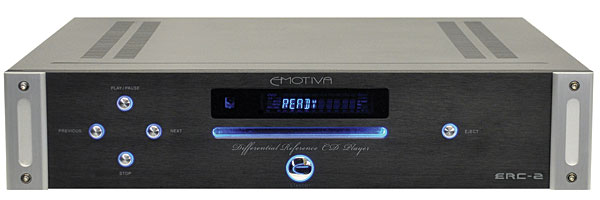
The Emotiva ERC-2 measures 17" (435mm) wide by 4.25" (110mm) high by 14" (360mm) deep and, at 17.5 lbs (8kg), is the heaviest component to enter my listening room since the 25-lb Simaudio Moon i3.3 integrated amplifier ($3300, discontinued). The player's distinct appearance was developed by Emotiva's president and CEO, Dan Laufman, and VP of engineering, Lonnie Vaughn. In building the ERC-2, their goal was to "keep it simple, easy to use, and elegant . . . in a machine-oriented way."
Indeed, the ERC-2 is clearly a machine. Its satiny black faceplate of brushed aluminum is capped at each end by a strip of stainless steel. To the left are four silver function buttons (Play/Pause, Next, Stop, Previous), arranged in a diamond; at center, from top to bottom, are the large display, a thin slot for loading discs, and a large Standby button adorned with Emotiva's distinctive E logo; to the right of these, all by itself, is the Eject button. This arrangement makes ergonomic sense, but it creates a louder, busier look than would a simple straight row of buttons.
Each button on the ERC-2's faceplate is lit by a halo of bright, clear blue 5that perfectly matches the bright, clear blue of the player's vacuum-fluorescent display. Like a Christmas tree, these blue lights set my small apartment aglow. Fortunately, the Dim button on the ERC-2's remote control softens the display and deactivates the halos. About that remote: It's a massive brick of milled aluminum designed to match the player's overall look and feel—in a word, manly.
Indeed, the ERC-2 and its hefty remote together exude an extremely masculine look and feel that I don't fully appreciate; I would prefer a quieter, more subtle appearance. To my eyes, the ERC-2's look is gaudy, boastful; I kept thinking that the women I know would find it unattractive. But every woman who entered my listening room and whose opinion I asked gave an ambivalent shrug. "As long as it works, I don't care," one said. "They all look the same to me." (And, yes, she was talking about the CD player.)
It took me a little while to get used to the ERC-2's slot-loading transport, which is made by Toshiba. First, it requires a careful touch: Line up the CD so that its edge is perfectly centered in the slot, begin to gently insert the disc, then let the player take the disc. If the disc is too far to either side of the slot, the player won't accept it. Second, the ERC-2's loading mechanism is slow: The review sample took up to 12 seconds to load a disc and up to four seconds to eject it, so be patient. Finally, once the player has loaded the disc, it immediately begins playing the disc from the beginning—if you want to hear track 5, you'll have to then select it using the front-panel buttons or the remote.
On the rear panel are: a set of balanced outputs; two sets of analog outputs; S/PDIF, TosLink, and AES/EBU digital outputs; a trigger input; a rocker power switch; and a standard IEC three-prong power receptacle for the included AC cord. Despite my feelings about its appearance, the ERC-2's build quality is undeniably impressive, with a level of fit and finish appropriate to a component costing three to four times as much.
Correct from the ground up
How does Emotiva keep their prices so low? According to Laufman and Vaughn, all Emotiva products are designed, distributed, and supported in Franklin, Tennessee, while manufacture and assembly take place in China. Laufman and Vaughn insist that their manufacturing partners are "totally committed to quality." I buy this. In addition to spending several weeks with the ERC-2, I've met and spoken with Laufman and Vaughn, and I trust that their enthusiasm and care for their company and its customers would be clearly communicated to Emotiva's colleagues overseas, ensuring that the company's values are appropriately respected. They take special pride in having built a loyal customer base and providing exceptional customer service, as is evident in their lively online community and events such as the annual Emofest: a weekend of factory tours, live music, and entertainment open to customers and friends.
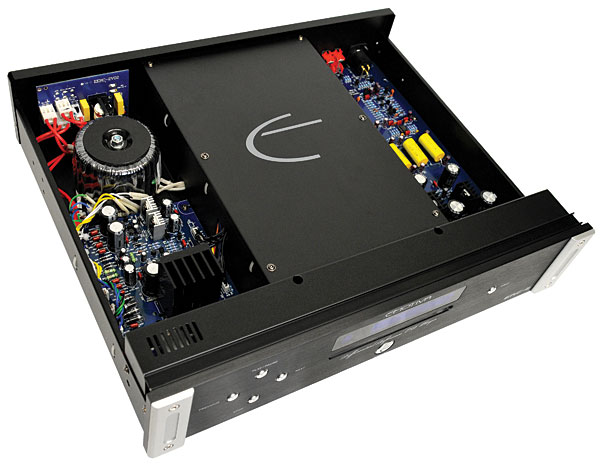
Informed by feedback from those customers, Laufman and Vaughn told me that they decided "to build a player that was correct from the ground up." Under the ERC-2's hood, four individually regulated and shielded power supplies drive the CD transport mechanism, VFD display, and digital and analog electronics. The result, according to Emotiva, is "dead-quiet ground-floor noise, extremely low distortion, and complete freedom from interaction between circuit elements." At the heart of the ERC-2 is a high-quality Analog Devices AD1955 24-bit oversampling DAC. The ERC-2 carries its balanced topology from the output of this chip straight through to the rear-panel XLR jacks.
Emotiva sells direct, with free shipping to anywhere in the continental US. All Emotiva products are backed by a 30-day "hassle-free" return policy and a five-year transferrable warranty.
Awesome music
Summvs (CD, Raster-Noton R-N132) is the fifth and final installment in the stirring and lovely Virus series of recordings from electronic composers Alva Noto and Ryuichi Sakamoto. In "By This River," a great open space is punctuated by wonderfully physical low-frequency pulses and startling high-frequency buzzes and chirps, while a rising progression of reverberant piano chords creates a lulling melody. Not only is the piece beautiful and emotionally powerful, it's a fine test of any system, filled with quick, hypnotic stereo effects, sudden stops and starts, and profoundly deep silences. I find it fascinating (and somewhat sad) that much of what makes this music special is lost through lesser systems. For instance, through my office system of Dell laptop and plastic computer speakers, "By This River" sounds disjointed, one-dimensional, and uninvolving; at home, through the hi-fi, it's a rich, soul-stirring experience.
The Emotiva ERC-2 CD player conveyed "By This River" with stunning impact and a very good sense of momentum and flow. Starts and stops were clean and precise, giving way to staggering silences and making the voluminous deep-bass blasts even more impressive. Hitting 82dB peaks, those blasts coursed through my listening room and sent fluttering the curtains 5' from my speakers' rear ports. Most satisfying, this bass was never bloated or loose, but always taut and well controlled. The ERC-2 quickly distinguished itself as a punchy, authoritative, muscular performer able to produce very quiet backgrounds while keeping a steady grip on the music. (I would have enjoyed hearing this track through the Boston Acoustics A25 loudspeakers I reviewed in the November issue, which have a similarly clean, forceful sound, but I no longer had them on hand.)
I have a rule: A good hi-fi component should make me want to listen to more music—drive me out of the office and into a record shop to explore more music. If it doesn't do that, something is very wrong. No matter how much it costs, what it looks like, or how sexy it might look to potential mates, if a component doesn't fuel my search for more new music, it's worthless.
The ERC-2's ability to present deep silences also benefited "Following Sea," a tender and slow-moving piece for brooding piano, gentle percussion, and swaying cello, from Sophie Hutchings' successful debut, Becalmed (CD, Preservation PRE 030CD). I could feel the silences between the notes, and all the exquisite sorrow and hope they held. At the same time, the ERC-2 revealed this track to be more dynamically limited than I'd thought it was—there was an overall lack of air and space and a hardness in the sound of the piano that I hadn't before noticed. While the emotional intensity of "Following Sea" remained intact, the music sounded less sumptuous and enticing than I'd become accustomed to hearing through my Exposure 2010S CD player ($1395).
Similarly, "Rivers of Water, Rivers of Mud," a propulsive hard-rock track from the mps, the debut album by my old band, the Multi-Purpose Solution (CD, Mint 400 M4R00 18), sounded threadbare and lacked coherence. We recorded this album in a small basement, almost entirely live and direct to tape, with very few splices or overdubs. It's littered with small blemishes. During the many late-night recording sessions, our drunken lead singer, Jim Teacher, fell into the charming habit of talking into the mike as the tape rolled. Partly in an effort to save time and money, and largely because we were lazy, we decided to leave these random bits of conversation in the recording and try to hide them in the final mix. While my Exposure 2010S manages to overlook these little flaws, the Emotiva had a funny way of throwing a spotlight on them and separating them from the music. Late in the chorus, when Jim Teacher is joined by ska artist King Django, the Emotiva presented Django's voice as clearly distinct from JT's, but also removed from the rest of the music, making it obvious that Django's backing vocal was recorded as an overdub.
But when fed well-recorded music, the Emotiva ERC-2's sound was always involving and thoroughly enjoyable. Mark Hollis's eponymous solo album (CD, Polydor 537 688-2) is an emotionally and sonically intimate affair filled with need and trembling with passion. The Emotiva presented "Watershed" in all its lovely, scintillating detail, the instruments fairly leaping from the speakers and into my listening room. Hollis's voice sounded appropriately rich and compelling as he slowly and carefully sang "Should have said so much / Makes it harder / The more you love." And when Hollis's voice gave way to Henry Lowther's brilliant trumpet solo, the Emotiva conveyed each note with startling force and agility, for a breathtaking and exquisite re-creation of this performance. It wasn't quite the same crazy physicality and realism I've heard through my Exposure player, but it was close, and it came with no deficiency in flow or momentum, and no appreciable sacrifice in the highs or lows.
But speaking of crazy physicality, Night Logic is a thrilling release from an especially fiery jazz trio: Marshall Allen on alto sax, Matthew Shipp on piano, and Joe Morris on double bass (CD, RogueArt ROG-0028). In "New Age for the Milk Sea Nightmare," the piano occupies the center of the stage, the bass is to the right, and the sax twists and turns from the left with beauty, grace, and force. Through the Emotiva, silences in this music were stark, detail was delicious, and the power with which Shipp pounds his keys, Allen blows his sax, and Morris runs up and down his bass was so staggering that, at about seven minutes in, when the trio reaches a chaotic climax, it was almost too much to endure. The entire track is a complex and furious 10 minutes of music in which the band unravels and recoils, whips and spirals into a devastating storm. The Emotiva painted it with great scale and drama while never breaking a sweat—a convincing and captivating performance.
Explore more music
I have a rule: A good hi-fi component should make me want to listen to more music—drive me out of the office and into a record shop to explore more music. If it doesn't do that, something is very wrong. No matter how much it costs, what it looks like, or how sexy it might look to potential mates, if a component doesn't fuel my search for more new music, it's worthless.
During my time with the Emotiva ERC-2 CD player, I found myself buying more CDs than I had in years. And I'm so happy about it. If not for the Emotiva ERC-2, I might not have experienced the full and heavy pleasure of Alva Noto and Ryuichi Sakamoto feeding my mind and expanding my listening-room walls with "By This River"—music of painful beauty and enormous soul. That alone is worth the meager $449. The rest is lagniappe. I could live without the blue lights and the big, fancy remote. I would hate to go on without the music.