



As general rule of thumb, I try not to review equipment from manufacturers of products that I personally own as it can lend an air of bias on my part. I’m just letting you know up front that I own a UMC-1 pre/pro and three amplifiers from Emotiva. I find their products to perform very well and are true bargains in the A/V world. The reason I allowed myself to indulge in this review of their XDA-1 was because I have never used an outboard DAC and felt I could review it without (too much) prejudice. I’ll admit, most of the audio shows I have attended that display fancy outboard DACs have usually left me thinking, “That’s nice, but why would I need one of those?” Hopefully, this review will help answer that question.
Specifications
- Design: Solid State Digital-to-Analog Converter (DAC)
- DAC: Multibit Sigma-Delta AD1955; 8x Oversampling
- Maximum Sampling Rate Accepted: 24 Bit, 192 kHz
- MFR: 5 Hz – 48 kHz
- S/N: 105dB (A-Weighted)
- THD+N: 0.001%
- Maximum Output: 12 Volts RMS
- Inputs: 2 Optical Toslink, 2 Coax Digital, 1 AES/EBU, 1 USB
- Outputs: 2 RCA (Unbalanced), 2 XLR (Balanced)
- Internal Volume Control: Digitally Controlled in 0.5 dB Increments
- Remote Control: Milled Aluminum Full Function Remote Control
- Fully Discrete Differential Output Stage
- Dimensions: 2.25″ H x 17″ W x 14″ D
- Weight: 6 Pounds
- MSRP: $349 USA
- Emotiva
Design and Setup
There are a fair amount of DACs on the market right now with many costing several times the price of the XDA-1. Part of what makes an out board DAC worth its salt is how it is implemented and how flexible it is for your particular needs.

The XDA-1 offers a balanced 24 bit/192kHz DAC/ pre amp designed around the AD 1955 chip set. The balanced line stage amp is combined with a differential output that is controlled by a digital volume that moves in increments of .5 steps (0-80). It has no less than six digital source inputs (1 AES/EBU, 2 coaxial, 2 optical and 1 USB: A/ B type). Where a 16 bit DAC has a S/N ratio of around 96dB (A-weighted), The XDA-1 comes in at 105dB. All standard resolutions are supported up to 192 kHz. For the outputs, you have fully discrete differential output stages with 2 independent balanced XLR and 2 unbalanced RCA (single ended) stages. The face plate is milled aluminum with a large, easy to read (and dimmable) VFD screen that displays the volume. Though the display can be dimmed, it can not be turned off completely. To the left of the screen is the volume and mute button. The ON/OFF (stand-by) button is black and not silver like the others. I almost did not realize it was there until I noticed it after I had fully set it up with my system. On the right of the display are a row of buttons that let you select the input. A small blue light identifies which selected input is engaged.
A fully functional remote is included, which is made from milled aluminum and populated with silver buttons that are not back lighted. Mute, volume and direct input selection can be controlled with the remote. Not many after market DACs come with a remote, so this was a nice touch and a convenient means of running several devices through the XDA-1 without getting up out of my chair.
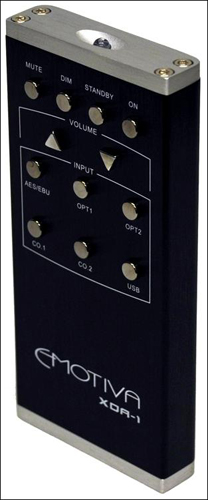
I felt that the remote was a bit over built and clunky, however, it was more impressive than a cheap plastic remote and certainly better than no remote at all! The remote is made from a chunk of billet aluminum and had some heft to it. It reminded me of the game of Clue: “I think it was Col. Mustard, in the library and he used the XDA-1 remote.” Yes, it is that hefty. The XDA-1’s 17 inch width is sized right for a rack mount, but is small enough and light enough to move from your main stereo system to your desk top computer. You could easily set an IPod transport on top of it (I’m thinking Wadia, myself) and pair it with a small amp and have a killer system somewhere else in the house (my wife is thinking kitchen). Come to think of it, a laptop would sit nicely on top of this as well. As you can see from the pictures, it easily fits in with the style of the other Emotiva gear.
Setting up the XDA-1 was fairly straight forward. For the first week I listened through an Oppo 980 using a coaxial (Zu Audio Firemine) to the XDA-1 and analog (Kimber PBJs) outs directly to two Emotiva UPA-1 monoblocks.
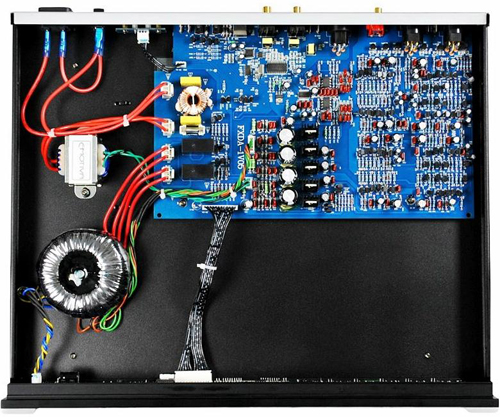
From there, I listened with my Revel F12s in full/direct mode. I achieved optimal output with the volume set to full (80) on the XDA-1, and used the volume control on the Oppo (and later on the pre/pro) to get my desired sound level output. My overall impression was that the Oppo and XDA-1 combo sounded better than listening with the Oppo 980 going through the UMC-1 alone. Not a night and day difference, but I generally always preferred the XDA-1s sound as it sounded a bit fuller and presented a slightly wider soundstage. Music was rock stable, broader and deeper than what I was getting through the Oppo to the pre/pro. In fact, the width of the soundstage was broader than I have ever heard from my Revels. I had always assumed that a narrower soundstage was just the part of their overall design, especially when compared to some of the recent coaxial drive speakers I had recently tested that project an almost holographic soundscape. This was probably my biggest revelation in reviewing the XDA-1. I also played some music via my wife’s laptop via the USB connection. You’ll have to turn off the Windows audio and make the XDA-1 the output device in the setup menu. Again, the music sounded great going through the XDA-1. I’m getting ready to begin the process of getting a home theater PC and I’m thinking the XDA-1 will be the cornerstone of that setup. With the remote in hand and 2 or 3 devices hooked in, the XDA-1 passed my “flexibility” test. I can think of several DACs out there that only allow access to one or two device at any given time, and they cost considerably more than the XDA-1.
As for the “implementation” test of the XDA-1, I had the fortune of being invited to a get-together with some audio enthusiasts (my wife would say “nerds”) to listen to some new Salk Song Towers.
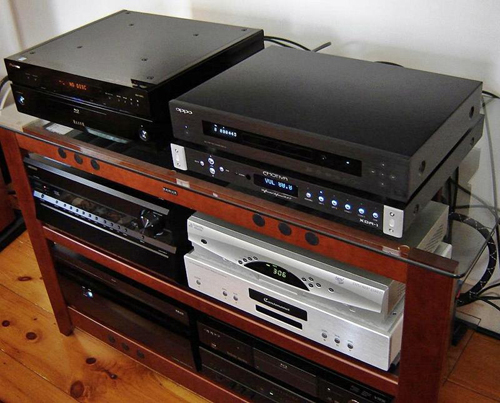
One guests brought a Pioneer BDD-09FD (around $1500 new) which employs 8 Wolfson DACs and another brought the impressive Oppo 93 ($499) which is equipped with Sabre DACs. We hooked the XDA-1 up with the 93 and ran all three units through a Parasound 2100 preamp that had a remote that allowed for instantaneous switching between the devices. Also, we had 2 exact CDs from the same artist and were able to adjust each output to the exact same volume and the track timer to within a few milliseconds. This allowed us to listen to the Pioneer, Oppo, and Oppo via the XDA-1 almost instantaneously. After an extended listening session, we all agreed that we could not tell the difference between the Pioneer direct, the Oppo direct or the Oppo via the XDA-1. We knew that the switching was taking place as there was a soft clicking sound as the button on the remote was depressed, but after a few minutes, we lost count as to which device was currently engaged. Their impressions were that they all sounded identical. My impression was that the XDA-1 sounded as good as the super built Pioneer and sounded indistinguishable from the esteemed Oppo 93. I expected it the XDA-1 to sound better that my old Oppo 980, but I was somewhat surprised that it could go head-to-head with the 93. I’m not knocking the other stuff, but the XDA-1 only costs $350 (when it is not on sale) with free shipping and a 30 day money back guarantee. Again, that price/performance thing comes to mind.
My last set of tests on the XDA-1 were to see if it could really take PCM at other sample rates other than 44.1 kHz. The one thing that I would have liked the XDA-1 to do was display the incoming sample rate as opposed to a static display of the volume. I’d like to display the SR and only see the volume when I hit the volume button on the remote. In any case, to verify that the XDA-1 was accepting other SR, I ran the 980 to the pre/pro, out the pre/pro via its digital outs to the XDA-1, out the XDA-1 via analog to the UMC-1 analog inputs and out again to the amps.
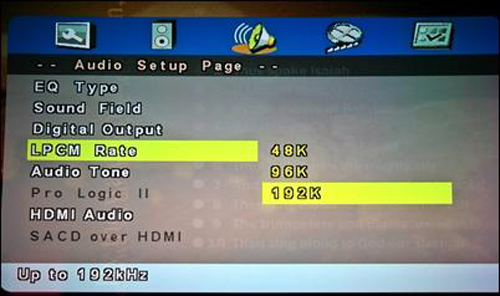
This overly complicated setup would allow me to see the SR displayed on the UMC-1 and verify that the XDA-1 was actually getting a higher SR. I don’t recommend this set up unless you really think it is useful. The XDA-1 does not up convert the SR, but it will accept whatever SR is sent to it.
In Use
There is something that you need to consider here. If you have a pre/pro or a source device that already has a great DAC, you may not need the XDA-1. If you have an older model CD player with digital outs or an older model receiver or processor…or a home theater PC with all of your precious music on it in a lossless format of your choice, the XDA-1 may be the thing you are looking for. I found myself going through dozens of CDs from my collection to critically listen to old familiar music.

I listened through my Oppo 980/XDA-1 and through my Sony BD-S570 via HDMI through my UMC-1. The sound of the XDA-1 was slightly fuller, with better stereo separation and expanded instrument placement than the 980, but it was considerably better sounding than the S570, which sounded thin and anemic in comparison. I also noticed no “clicks” in between tracks on music that I sometimes hear when going through my pre/pro. In fact, the XDA-1 was deathly quiet, or perhaps I should say my F12s were quiet when the music came to a close. Even up close, I did not detect any hissing from my speakers. This may also be in part to my new monoblocks, but I don’t think you should expect to hear any sound quality loss via the XDA-1. Of all my listening sessions, I felt that the Oppo to the XDA-1 and the XDA-1 directly to the amps provided the best sound quality overall. This set up would make for a super two channel system that would be easy enough to operate for your wife or teen aged kids. Like I said, you turn it on and select your input. Sit back and listen. It is that simple.
Conclusions
If you are only into movies and home theater, or only listen to multichannel music or vinyl, the XDA-1 may not be of any use to you. Same holds true if you already have a very good DAC in your current system. But, if you are thinking of using a computer, media server, or have an older inferior DAC in your current setup, the XDA-1 can really squeeze some good sound out of your current system. I’d prefer that it display the incoming sample rate and be able to completely turn off the lights on the front panel, but these are minor quibbles. For the money, I can’t think of many other DACs that offer the sound quality, flexibility…and a killer remote…that Emotiva offers with their XDA-1. As I prepare to move my music onto a computer, the XDA-1 will be my bridge to the digital future.