


Designing
The Chorus 800V series is the second from the bottom of the four families of speakers Focal designs for two-channel home audio. (The Utopia Be line is their flagship series, and the Chorus 700V speakers comprise their entry-level line.) The 800V series includes two bookshelf and three floorstanding models that range from $795 to $2995/pair, as well as several home-theater models. I chose the larger of the bookshelf designs, the 807V ($995/pair).
I was immediately struck, with every recording I tried, by the natural, detailed, organic, and holographic midrange of the Chorus 807V. All vocal recordings were stunning. I mined my collection for the best-sounding vocals, which meant hitting the vinyl stacks as well. The title track of Doris Day's Cutting Capers (LP, Columbia C 11232) reveals her voice in its 1950s prime, in all its golden, silky, breathy glory—as if she's bathed in light against a backdrop of delicate, natural orchestral textures. I'm also a fan of the early Joan Baez; her rendition of Bob Dylan's "It Ain't Me Babe," from Joan Baez 5 (LP, Vanguard VSD 79160), with that seductive, birdlike vibrato in her high register, was arresting through the 807V. The speaker's capabilities of subtle, low-level dynamic articulation almost let me hear Baez's head and throat as two distinct point sources.
The Chorus 800V series is the second from the bottom of the four families of speakers Focal designs for two-channel home audio. (The Utopia Be line is their flagship series, and the Chorus 700V speakers comprise their entry-level line.) The 800V series includes two bookshelf and three floorstanding models that range from $795 to $2995/pair, as well as several home-theater models. I chose the larger of the bookshelf designs, the 807V ($995/pair).
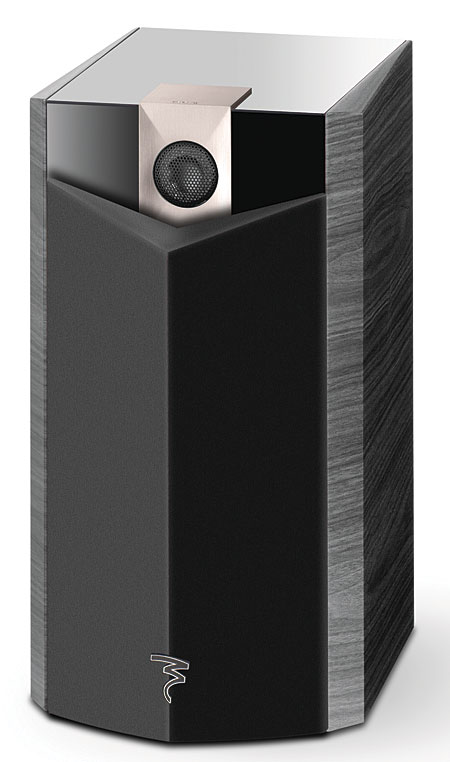
The Chorus 807V is a front-ported, two-way speaker with a 1" TNV aluminum-magnesium inverted-dome tweeter and a 7" Polyglass-cone woofer. Focal America's Daniel Jacques explained to me that the tweeter voice-coil is attached midway along the dome rather than on the periphery, as in most tweeters. He claimed that this improves the driver's pistonic movement, to give greater speed and better control. Jacques also claimed that Focal doesn't believe in ferrofluid cooling: "How fast can you walk when you are in a pool?"
The 807V looks stunning. Focal employed the Parisian design house of Pineau & Le Porcher to develop the attractive "V" look, which combines polished, acrylic-covered ebony with a highly figured finish of moka wood. I set the speakers on my trusty, 24"-high Celestion Si stands, which were loaded with sand and lead shot. I noticed no difference in their performance with their grilles on or off, so I left them on—the V-shaped grille is a key part of the speaker's appearance. The Chorus 807V is not magnetically shielded.
Listening
I was immediately struck, with every recording I tried, by the natural, detailed, organic, and holographic midrange of the Chorus 807V. All vocal recordings were stunning. I mined my collection for the best-sounding vocals, which meant hitting the vinyl stacks as well. The title track of Doris Day's Cutting Capers (LP, Columbia C 11232) reveals her voice in its 1950s prime, in all its golden, silky, breathy glory—as if she's bathed in light against a backdrop of delicate, natural orchestral textures. I'm also a fan of the early Joan Baez; her rendition of Bob Dylan's "It Ain't Me Babe," from Joan Baez 5 (LP, Vanguard VSD 79160), with that seductive, birdlike vibrato in her high register, was arresting through the 807V. The speaker's capabilities of subtle, low-level dynamic articulation almost let me hear Baez's head and throat as two distinct point sources.
The most captivating aspect of the Chorus 807V was its high-frequency performance. Its resolution of detail, speed, and extension of the highs told me that this speaker has one remarkable tweeter. When I played Tiger Okoshi's Two Sides to Every Story (CD, JVC JVCXR-0004-2), his trumpet's blatty bite had the attack, spit, and golden glow of a live trumpeter in my living room. Nor was his a sweet-sounding horn; on every track it was in my face, dominating the mix, exactly as it would had Okoshi been standing there in my living room.
Derek Bailey uses unorthodox picking and plucking techniques on both acoustic and electric guitar to create the remarkable improvisations on his Solo Guitar Vol. 1 (CD, Incus CD10). To hear Bailey's unique dynamic phrasings properly, it's essential that a speaker's tweeter be able to unravel every subtle nuance of his playing. I listened to the entire CD through the 807Vs and was reminded of a time in the 1980s when I sat 10' from Bailey at a live performance.
On certain recordings, however, the extreme high frequencies seemed a bit emphasized. The sibilants of all closely miked female vocalists on familiar recordings—such as "Hey, Sweet Man," from Madeline' Peyroux's Dreamland (CD, Atlantic 82946-2)—seemed a bit more prominent than I remembered hearing them through other speakers. The Focal's tweeter was also very revealing of less than pure high-frequency content. In the title track of Hole's Celebrity Skin (CD, Geffen DGCD-25164), the high frequencies are a bit hashy and trashy. With most speakers I've tried, this has not deterred me from cranking up this tune to live rock-concert levels and dancing around the room. But the Chorus 807V so laid bare the recording's distorted, compressed highs that I ended up uninterested in hearing the rest of the disc.
The Chorus 807V's bass was extended and forceful for a "bookshelf" speaker. With all recordings the bass was fairly clean, tight, and uncolored, though I found the lower range of electric bass guitars (eg, Chad Watson's on Janis Ian's Breaking Silence CD, Analogue Productions CAPP 027) and string basses (eg, Ray Brown's solo on "I'm an Old Cowhand," from the CD of Sonny Rollins' Way Out West, JVC VICJ 60088) to be a touch warm and supple, while still sounding natural. This wasn't, however, noticeable with electronic rock recordings; the synth bass and drum machine on Sade's Love Deluxe (CD, Epic EK 53178) were clean, tight, and powerful. Moreover, the 807V's superb resolution of detail made it simple to pick out all the electronic processing effects on this recording.
Playing recordings of bombastic orchestral works, I was very impressed with the Chorus 807V's lower bass range. From the timpani passage in the first movement of David Chesky's Violin Concerto, from his Area 31 collection (SACD/CD, Chesky SACD 288), to the bass drum in the finale of Stravinsky's The Firebird in the recording by Antal Dorati and the London Symphony (CD, Mercury Living Presence SR90226), I felt I was listening to larger, more dynamic floorstanders. I had the same reaction to the opening tracks of Kraftwerk's Minimum/Maximum (CD, EMI ASW 60611)—when cranked to rock-concert levels, they shook the room without compression, distortion, or strain.
I compared the Focal Chorus 807V ($995) with the Nola Mini ($695 when available), the Amphion Helium2 ($1000), and the Monitor Audio Silver RS6 ($1000). (All speaker prices are per pair.)
The Focal Chorus 807V is an attractive and revealing loudspeaker of very low coloration and high versatility that gave me hours of enjoyment with a wide range of program material. I also feel that, at $995/pair, it is a superb value for the money. However, its tweeter is so extended in range and consequently so revealing that careful matching with other components and recordings is warranted. With the finest associated gear and recordings, the Chorus 807V achieved a level of performance that competed with much more expensive speakers. I commend Focal for trickling down the technology of their more expensive wares to such an affordable realm.
But to really appreciate this ruthlessly revealing speaker, I had to trot out the highest-quality recordings I had. Then I was rewarded with staggering realism for the price. Timothy Seelig and the Turtle Creek Chorale's recording of John Rutter's Requiem (CD, Reference RR-57CD) bloomed with richly layered vocals, and a sense of ease and naturalness around the organ. The pedal notes were natural-sounding and seemed quite extended (how low do these puppies go, JA?), but never seemed overpowering or in my face.
I've played Kohjiba's Transmigration of the Soul, from the Santa Fe Chamber Music Festival's Festival (CD, Stereophile STPH007-2), many times, but with the Chorus 807V I was struck by the upper partials of Carol Wincenc's flute—I had never before heard this recording with so much air. Cellist Peter Wyrick's bowed attacks had much more power, finesse, and articulation than I'd noticed before, and Tyler Mack's timpani reverberated off the surfaces of the St. Francis Auditorium before naturally decaying. However, the loudest thwacks in the marimba's upper register were more prominent than I'd remembered.
I've spent a long time listening to Live at Merkin Hall, John Atkinson's recording of my jazz quartet, Attention Screen (CD, Stereophile STPH018-2). However, the Chorus 807V was the first speaker to let me completely warm up to this recording and analyze our performance—it sounded as if I'd been transported back to the Merkin's stage. The mid-1990s Steinway D piano I played that day was as good as any instrument I've ever played (so much for the theory that new Steinways aren't as good as older ones), but only with the Focal did the opening piano passage of "Mansour's Gift" sound exactly as that piano had sounded that day in February. The more I play with drummer Mark Flynn, the more I am in awe of his technique, passion, versatility, and economy. Listening to the simple funk backbeat he lays down at the beginning of "Blizzard Limbs," I found myself staring at the dynamic articulation of his simple, wet-sounding bass-drum foundation and his carefully placed snare shots. Through the Chorus 807V, his cymbals sounded as natural as when I've heard him live.
Comparing
I compared the Focal Chorus 807V ($995) with the Nola Mini ($695 when available), the Amphion Helium2 ($1000), and the Monitor Audio Silver RS6 ($1000). (All speaker prices are per pair.)
The midrange performances of all four speakers were in the same league with respect to lack of coloration, resolution of detail, and organic low-level dynamic articulation. The main differences among these speakers lay in their high-frequency presentation, bass extension, and high-level dynamic performance. The Nola Mini had considerable high-frequency detail but was not as extended as the Chorus 807V and seemed a bit more relaxed in that region. The Nola's bass extension was comparable to the Focal's, but the latter had superior high-level dynamic slam.
The Amphion Helium2 also had quite extended highs that were pure and detailed, but its extreme top seemed a bit softer and more pillowy, a characteristic I find appealing with all recordings. The Helium2's low-frequency extension and high-level dynamics weren't even close to the Chorus 807V's, however.
Finally, the Monitor Silver RS6's highs seemed almost as extended as the Focal's, but the RS6 was a bit more forgiving at the extreme top end. The floor-standing Monitor's bass extension and high-level dynamic performance, however, were by far the strongest of the group.
Concluding
The Focal Chorus 807V is an attractive and revealing loudspeaker of very low coloration and high versatility that gave me hours of enjoyment with a wide range of program material. I also feel that, at $995/pair, it is a superb value for the money. However, its tweeter is so extended in range and consequently so revealing that careful matching with other components and recordings is warranted. With the finest associated gear and recordings, the Chorus 807V achieved a level of performance that competed with much more expensive speakers. I commend Focal for trickling down the technology of their more expensive wares to such an affordable realm.
Description: Two-way, bass-reflex, stand-mounted loudspeaker. Drive-units: 1" (25mm) TNV aluminum-magnesium inverted-dome tweeter, 7" (180mm) Polyglass-cone woofer. Crossover frequency: 3kHz. Frequency response: 50Hz–28kHz, ±3dB. Low-frequency point: 41Hz. Sensitivity: 92dB (2.83V/m). Impedance: 8 ohms nominal, 4.2 ohms minimum. Recommended amplification: 25–175W.
Dimensions: 17.5" (448mm) H by 9.2" (237mm) W by 13" (333mm) D. Weight: 22.2 lbs (10.1kg).
Finish: Ebony-Moka.
Serial Numbers Of Units Reviewed: 10A003579/80.
Price: $995/pair. Approximate number of dealers: 161.
Manufacturer: Focal-JMlab, BP 374-108, rue de l'Avenir, 42353 La Talaudière cedex, France. Tel: (33) 04-77-43-57-00. Fax: (33) 04-77-37-65-87. Web: www.focal-fr.com. US distributor: Audio Plus Services, 156 Lawrence Paquette Industrial Drive, Champlain, NY 12919. Tel: (800) 663-9352. Fax: (866) 656-0686. Web: www.audioplusservices.com.
Dimensions: 17.5" (448mm) H by 9.2" (237mm) W by 13" (333mm) D. Weight: 22.2 lbs (10.1kg).
Finish: Ebony-Moka.
Serial Numbers Of Units Reviewed: 10A003579/80.
Price: $995/pair. Approximate number of dealers: 161.
Manufacturer: Focal-JMlab, BP 374-108, rue de l'Avenir, 42353 La Talaudière cedex, France. Tel: (33) 04-77-43-57-00. Fax: (33) 04-77-37-65-87. Web: www.focal-fr.com. US distributor: Audio Plus Services, 156 Lawrence Paquette Industrial Drive, Champlain, NY 12919. Tel: (800) 663-9352. Fax: (866) 656-0686. Web: www.audioplusservices.com.