


Keith Herron plopped himself down in my listening chair and smiled, clearly pleased with the sound of my system now that his M150 monoblock power amplifiers had been substituted for my Musical Fidelity Nu-Vista 300. He began to tell me why.
The M150 is a fully complementary symmetrical bipolar design, and if that means nothing to you, don't worry about it. What's more important is how Herron described it to me in plain English.
I stopped him. While I appreciated his enthusiasm, I explained why it's a no-win situation to suggest to a reviewer what he's going to hear. The more a manufacturer tries to plant ideas in a reviewer's head, the more the reviewer feels trapped, and the more likely he is to break away and hear something else.
Herron agreed and bit his tongue, but not before telling me he wanted me to hear his complete system: Herron M150 amps, upgraded "A" versions of the Herron VTSP-1 tube preamp and Herron VTPH-1 phono preamp that I reviewed in March, 2000, all connected with the Herron cables he was about to market. I agreed—but only after first listening to the M150s with the Hovland and Ayre K-1x preamps and the Audio Research Reference phono section, using familiar cables.
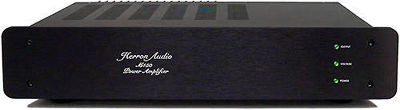
Much research tells us that what we see can sometimes affect what we hear, and I kept that in mind while reviewing the M150. While some amplifiers demand shelf or floor space for their looks, that can't be said for the homely M150—its folded sheet-metal chassis is about as plain as it gets. In that department, the dramatic-looking, $16,000/pair Audio Research VTM200 that I reviewed in January would be a hard act to follow, but even compared to the similarly priced Nu-Vista 300 ($5495), the $5895/pair M150 pales. That says a great deal about what Keith Herron thinks he's accomplished and for whom he's accomplished it.
Herron, a music-lover and a no-nonsense electrical engineer with a background in professional audio—in the late 1980s and up until 1992, he was director of research and development at SLM (St. Louis Music) Electronics, who make Crate and Ampeg gear. He was also involved in designing a bar-code documentation system for Chrysler that determines what parts and accessories go on which minivan chassis as it rolls down the assembly line.
For his own line of electronics, instead of concentrating on frills and fancy faceplates, Herron has put his money into R&D, and into parts and design quality—he's convinced that there's a ready and willing marketplace for his "musical accuracy first" designs. As I wrote last March, in my review of his preamp and phono section, Herron approaches the marketplace in a cautious, stealthy manner, working from the ground up to grab the ears of audiophiles.
Inside the M150
The M150 is a fully complementary symmetrical bipolar design, and if that means nothing to you, don't worry about it. What's more important is how Herron described it to me in plain English.
In most tube and solid-state designs, beginning with the input stage, each stage drives the next until there's enough voltage gain to drive the output stage, which provides the main current gain and drives the loudspeakers. According to Herron, solid-state output devices are usually the slowest and tend to have poor linearity at very small signal levels. In other words, they "go to sleep" at the very low levels where music "lives."
Herron showed me in a diagram how he "seamlessly" routes each stage directly to the output stage, as opposed to just stacking the stages atop each other. Along with a unique output-stage configuration, his design is said to eliminate the usual need for high output-stage (or continuous class-A) idle currents, which generate lots of heat. The unique circuit design is one reason these amps are so compact—and, as advertised, they run incredibly cool. Even rocking at moderately high volumes, they remained literally cool to the touch. I'm playing a test pressing of Classic Records' reissue LP of Led Zeppelin IV as I write this (such torture!), and there's almost no heat coming from the M150s.
There are no DC-blocking coupling capacitors in the forward direction of the circuit. For speaker protection, the M150 uses automatic low-level direct-current offset cancellation, plus high-level DC shutdown. Herron believes fanatically in low distortion, and claims that proper stage-to-stage impedance matching ensures extraordinarily low distortion. Combined with what he described to me as "successive stage to output confluence," the claimed result is "a seamless combination of micro/nano-resolution from forward stages and robust controlled power and authority from successive stages."
Using the M150s was simple. Speaker connection is via five-way TIFF binding posts, and there's a gold-plated RCA jack on the rear for the input. An IEC jack allows you to play with AC cables, and there's an AGC 6 speaker-output protection fuse that you can change, depending on what power your speakers can handle. If your "audio guru" tells you such fuses are "directional," go for it! I didn't touch the fuses in my review samples.
Though I asked him not to spoonfeed me what I was going to hear, Keith Herron isn't shy about describing the sound of his amps in his product literature: "A live presentation with none of the hardness normally associated with solid-state amplifiers," along with "the fine resolution and liquidity normally associated with tube amplification plus the power and bass control of solid-state."
At the Y2K Consumer Electronics Show, I had been listening to a pair of loudspeakers that sounded diffuse, listless, and not particularly well-organized. Keith Herron entered the room with his unimpressive-looking amps under his arms. Out went the large, aluminum-faceplated amp with its blue LEDs, and in went these old socks of a pair of monoblocks. Suddenly, the same musical selection we had been listening to took on form, shape, and substance. Bass tightened, and there was a focus on rhythm, pitch, and texture. The difference was remarkable. The former diffusion gave way to a compact, organized, well-focused soundstage—but not an enveloping one.
When you flip on the rear-mounted power switch, three lights go on in sequence: The first indicates Power to the unit, the second that Voltage has been applied to the circuitry, and the third that the Output relay has been engaged and you can begin listening. If DC is present at the input, the Voltage light will blink to alert you. If the Output light turns red and the Voltage light goes out, you've overheated the amplifier (its temperature has exceeded 78 degrees C). It will shut down, and remain shut down until the heatsinks cool off by 10 degrees C.
Listening
Though I asked him not to spoonfeed me what I was going to hear, Keith Herron isn't shy about describing the sound of his amps in his product literature: "A live presentation with none of the hardness normally associated with solid-state amplifiers," along with "the fine resolution and liquidity normally associated with tube amplification plus the power and bass control of solid-state."
Herron may have smiled when he installed his amps in my system, but my own first reaction was different. Having just spent time with the Nu-Vista 300 and M3 and, of course, the Audio Research VTM200 monos, I'd become used to a big, "bloomy" soundstage and a rich midbass. In comparison, the Herron M150s sounded small and created a more distant picture. That much was immediately apparent from my less than "sweet" listening spot. So why was the designer smiling?
Herron feels that most power-amp designs add a warmth or lushness that's not present in the recording or the real world. That added sound is part of what contributes to the bloom of some gear, and that bloom helps create a false sense of a big space.
Whatever the cause, the Audio Research VTM200s produced an enormous, exciting, and enveloping soundstage, though of course its size depended on the recording. The Musical Fidelity Nu-Vista's stage was scaled back somewhat, but the Herrons' picture was the most modest and, ultimately, the most tidy. From Herron's point of view, "modest" and "tidy" are not negatives.
My perception of the Herrons' sonic picture was reinforced when I substituted his revised preamp and phono section for the Hovland, and somewhat less so when I substituted the Herrons for the Ayre K-1x. While this is supposed to be a review of the M150, I'm going to make it a review of the Herron system, because I believe that most buyers will gravitate toward the full package, even if only one piece at a time.
Different experiences
At the Y2K Consumer Electronics Show, I had been listening to a pair of loudspeakers that sounded diffuse, listless, and not particularly well-organized. Keith Herron entered the room with his unimpressive-looking amps under his arms. Out went the large, aluminum-faceplated amp with its blue LEDs, and in went these old socks of a pair of monoblocks. Suddenly, the same musical selection we had been listening to took on form, shape, and substance. Bass tightened, and there was a focus on rhythm, pitch, and texture. The difference was remarkable. The former diffusion gave way to a compact, organized, well-focused soundstage—but not an enveloping one.
A year later, the M150s and the rest of the Herron gear produced the same sound in my system, but now my reaction was mixed. One of the things I admire most about the Sonus Faber Amati Homage speakers in my new, well-treated listening room is the grounded soundstage I get. The experience of sonic images "floating" in air without legs bothers me; among the few negative observations I have about the Herron system (and about the M150s by themselves when I drove them with the Hovland or Ayre preamps) is the imaging and soundstaging they produced: pictures floating in air.
When you're in a jazz club, you hear a combination of direct and floor-to-ceiling reflected sound; superb live recordings like Mel Tormé and Friends at Marty's (Finesse W2X37484) should put you convincingly in the club where they were recorded. When I listened to the M150s with the lights out and my eyes closed, three (or more or fewer, depending on the recording technique) well-focused spheres of sound hovered across the soundstage. The entire picture floated off the ground, and that sensation remained constant whether the music had been recorded with three spaced omni microphones, à la Mercury Living Presence, or the multi-miked production used for the Tormé album.
It could be argued that this homogenization of the amplifiers' soundstage could have been speaker- or room-related, but the speaker placements were made according to RPG's computer program, and have proved ideal for all speakers and electronics I've reviewed in the room. I certainly didn't position the speakers to complement or "frequency-balance out" my reference amplifiers.
But let's go back to the positives I heard from the M150s that first time in Las Vegas and in every listening session at home: The amplifiers were superbly well organized in time. They were rhythmically coherent, creating a correct sense of musical organization. And yes, they were "liquid," sounding neither "tubey" nor "solid-state." I have to agree with Herron's assessment of his amplifier: To me, it sounded remarkably neutral tonally and harmonically, extremely well-focused without etch or grain, and offered the low-frequency control of a good solid-state amp and the smooth, liquid detail of a good tube amp. He's accomplished all of that, and that's a great deal. Mel at Marty's may not have had "legs" to stand on, but the rest of the presentation was superbly neutral, detailed, and honest...though I've had a greater sense of being able to reach out and "touch" the performance with other amplifiers in the same system.
The Herron M150s reminded me of the Infinity Prelude loudspeakers I reviewed in the May 2000 Stereophile. Infinity worked hard to create a truly "flat" loudspeaker by eliminating "peaky" tweeter performance; the result was a smooth-sounding speaker that initially sounded as if it didn't really have extended highs or a great deal of detail. In fact, the Prelude had both, as did the Herron monoblock. Extended listening revealed that the speaker's top end was airy and extended, and the flatness of the response revealed incredible inner musical detail, especially among different instruments inhabiting a similar frequency band.
Have you ever seen an unsure animal poking and prodding another one that's playing possum as a defense? That's how I felt during my months with the Herron M150s. It's quite possible that I listened right past one of the finest amplifiers ever designed and mistakenly heard one that's merely very, very good. I poked and prodded, but was never sure what I was hearing. The Herron M150s always delivered music, and without tacked-on glaze, glare, grunge, or too much or too little of anything. They never sounded bright, dull, rich, threadbare, compressed, weak, or strong. Was their tonal balance utterly neutral or utterly bland? I'm not sure, for while I always respected what I heard, I was rarely enthralled or moved. I was enthralled and moved by the music, but not by the amplifiers. Maybe that's more of an indictment of my listening preferences than it is of the amps' performance.
Details Galore
The Herron M150s reminded me of the Infinity Prelude loudspeakers I reviewed in the May 2000 Stereophile. Infinity worked hard to create a truly "flat" loudspeaker by eliminating "peaky" tweeter performance; the result was a smooth-sounding speaker that initially sounded as if it didn't really have extended highs or a great deal of detail. In fact, the Prelude had both, as did the Herron monoblock. Extended listening revealed that the speaker's top end was airy and extended, and the flatness of the response revealed incredible inner musical detail, especially among different instruments inhabiting a similar frequency band.
The Herron, like the Preludes, was designed to be listened into, not to blow you away in your seat. There was nothing sparkly or crystalline about the M150's high-frequency performance, nor was there anything dull, rolled-off, or muffled.
This self-effacing quality made the M150 less than the most exciting amplifier I've ever heard, but one that should satisfy many listeners over the long haul. It imparted very little of its own sonic character on the music, but most of the character that I did notice with any consistency was subtractive in nature. Sometimes I'd feel that the M150 shortchanged macrodynamics (it certainly got microdynamics correctly), but then I'd put on a record like Classic's 45rpm edition of Mussorgsky's Pictures at an Exhibition (Reiner/CSO), and the full orchestral slam was there. Whenever I started thinking the Herron lacked deep, authoritative bass, some familiar low note would come along, and there would be no doubt that the amp had dug down very deep while remaining extremely well-controlled.
But when there wasn't an obvious low-frequency fundamental, as in a bass-guitar line, I felt a lack of midbass presence. Perhaps that's what Herron calls "bloom," but I think it was part of why the soundstaging lacked "legs," at least in my room with the Amati Homages. And it may have contributed to the other subtractive qualities I consistently noticed: images, though solid, lacked body weight, and the soundstage always opened from the speakers back, never seeming to project forward into the room. As a friend put it, "You can't wrap yourself around the picture." Or sense that you can walk into it, as you can with some other amplifiers.
Nonetheless, the Herrons did produce an accurate soundstage in terms of depth and width—it's just that the picture never existed forward of a line drawn between the speakers, and that the overall picture was more compact than the one drawn by some other amplifiers. For better or worse, the Herrons' clarity laid bare with ruthless precision the microphone techniques used by many well-regarded engineers: clusters of musicians standing around microphones at Columbia's old 30th Street studio were exposed populating the soundstage of Duke Ellington's phenomenally spacious and well-recorded Piano in the Background (Columbia CS 8346, "six-eye").
Herron values lack of coloration over harmonic drama, and the M150 seemed to be colorless—a word that has both negative and positive connotations. On the positive side, it meant that the lack of vivid, additive colorations from the amp—which, while exciting in the short haul, can grate and bore over time—allowed the true harmonic makeup of instruments to shine through. I believe that the M150 is among the most neutral amplification devices I've yet encountered—I never could get a harmonic handle on its sound. On the other hand, I was seldom excited or enthused by what I heard. My response was more a consistent feeling of respect and appreciation for Keith Herron's clearly brilliant balancing act.
That may not be a bad thing. In fact, it had me thinking back to the time I spent with the pair of Audio Research VTM200s. These monoblocks got my adrenalin pumping with their big 3D images, dramatic soundstaging, and intensely dynamic swings...but I had trouble with their string tone. I don't blame Audio Research's Terry Dorn for saying, in his "Manufacturer's Comment," that I got that part "wrong"—he might be right—but it's what I heard.
String tone from the Herron amps was far more sonorous and liquid—and that's from a solid-state amplifier—but their overall sonic picture was far less intense, less transparent, and much less entertaining. Perhaps with that last comment I've damned myself as a seeker of sonic thrills. So be it. Perhaps all Herron is selling is "music." Perhaps, with my music, I want a roller-coaster ride.
Conclusion
Have you ever seen an unsure animal poking and prodding another one that's playing possum as a defense? That's how I felt during my months with the Herron M150s. It's quite possible that I listened right past one of the finest amplifiers ever designed and mistakenly heard one that's merely very, very good. I poked and prodded, but was never sure what I was hearing. The Herron M150s always delivered music, and without tacked-on glaze, glare, grunge, or too much or too little of anything. They never sounded bright, dull, rich, threadbare, compressed, weak, or strong. Was their tonal balance utterly neutral or utterly bland? I'm not sure, for while I always respected what I heard, I was rarely enthralled or moved. I was enthralled and moved by the music, but not by the amplifiers. Maybe that's more of an indictment of my listening preferences than it is of the amps' performance.
My only reservations were about the M150's subtractive qualities: Maybe it was a bit light in the midbass, or lacked natural, not artificial, bloom—but Keith Herron is anti-bloom, convinced that bloom isn't in the music and shouldn't be in the audio system. The M150 was about the most neutral amplifier I've yet encountered, and that's why I felt it was playing possum with me—I kept wanting for it to show its true nature. Perhaps, in its unwavering neutrality, it was.
Still, I was troubled by the M150s' lack of soundstage "legs," and by their self-effacing-to-a-fault, non-vivid overall presentation. I wanted more solidity and dimensionality, more balls. But amplifiers don't have balls—or breasts or butt cheeks, for that matter. We always say we want the electronics to get out of the way and let the music through. The M150s may very well do that better than any amplifier I've yet encountered. If so, I'm ashamed to say that, at the end of the day, that's not what I want.
Call me an "audiophile." In some circles, you couldn't call me worse! Perhaps the combination of the M150s and the Amati Homages was not a good one. Or perhaps Keith Herron has designed out more than just the colorations of most amplifiers. Maybe he's gone overboard and, in his desire to design out colorations, has designed out some of the life of recordings and music.
You'll have to be the judge of that—and I strongly recommend that you put on your black robe and find out. Don't let the M150's plain looks fool you: it's a special amplifier that deserves your serious attention.