


Fully Serviced
All items are meticulously serviced and restored to meet factory specifications
$0.00 USD
$0.00 USD
PS Audio
The Gain Cell is styled in the same sleek, industrial look as the rest of the Stellar line and comes in the same silver or black choice of finish. The chassis measures 17” x 12” x 3”. The front sports a volume control, 1/4” headphone jack and a blue lit power/standby button. The Stellar Gain Cell’s rear panel features an analog section with 3 pairs of line inputs and one XLR pair. The output section offers both balanced and unbalanced connections and its digital input section offers a plethora of digital options – USB, Toslink, coax and I²S (what looks like an HDMI input). The Gain Cell includes a trigger function for powering the Stellar on and off with other components and a main power switch located next to its IEC connector. The Gain Cell comes complete with a nice, useful remote that, other than basic functions, offers access to three digital filters as a means of fine-tuning for greater system synergy.
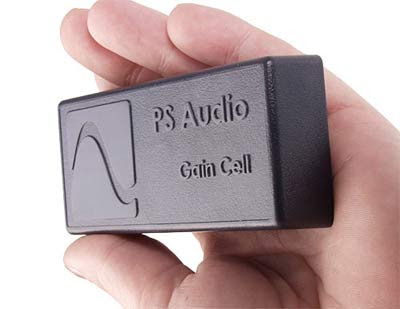 According to PS Audio, “The real challenge designing the Gain Cell DAC was making sure both PCM and DSD were handled in a way that sacrificed as little as possible through the playback process.” Chief engineer Bob Stadtherr and CEO Paul McGowan worked together designing the ins and outs of the Gain Cell, “making decisions on power supplies, overall architecture, developing a custom, simplified FPGA for the input stage and voicing the output stage in a balanced and musical manner that honors both PCM and DSD formats.”
Paraphrasing from the PS Audio website, the heart of the Gain Cell DAC analog preamplifier section is its “Variable Gain Cell,” invented by McGowan in the early 2000’s to eliminate the need for adding additional circuitry for a volume control, simplifying the signal path. The Gain Cell relies on a different topology known as the Gilbert Cell, topology invented to allow the preamplifier amplifier stage to vary its own gain in response to front panel volume control position. Widely used during the 1960’s in recording studios until digital replaced it, this method requires zero additional circuitry in the signal path and offers more than 80 db of attenuation to properly equal most high end preamplifiers, if designed properly.
The Gain Cell has 100% analog input switching and, when used in conjunction with the Variable Gain Cell, allows the user to listen within the analog domain. Coupled with a great DAC, this allows flexibility. The Stellar Gain Cell and preamp stage are fully balanced from input to output (unbalanced is also included as noted above).
The the Gain Cell DAC chief architect was Bob Stadtherr, hand-tuning and voicing was completed by Paul McGowan and Darren Myers (the Stellar M700 mono amplifier was his baby). More from PS Audio’s site “All input signals are taken into the Gain Cell DAC in Native Mode, without Sample Rate Conversion (SRC) and fed directly into a simplified FPGA known as a CPLD (Complex Programmable Logic Device), which discovers [the] sample rate and format, reclocks all incoming data, reduces jitter, wave shapes data output to the DAC chip, and utilizes high speed/low gate count logic to reduce propagation delay for faster throughput. This proprietary technology is called the Digital Lens.”
The acclaimed 32-bit ESS Sabre DAC chip, with its Hyperstream architecture, was selected for duty in the Gain Cell DAC. “The output is passively filtered to reduce transient distortion. the Gain Cell DAC’s power supply includes a large analog transformer, 7 regulators, properly-bypassed high-speed switching diodes, and a massive 15,000 mFd of storage capacitance.” The output stage is a unique, fully balanced and direct coupled hybrid array Class-A configuration, with an extended bandwidth feeding directly into Stellar’s Gain Cell.
A little more from PS Audio “The Gain Cell DACs I²S inputs are… compatible with [the PS Audio] DirectStream Transport… The DirectStream Transport is one of only a very few players to output pure DSD from the locked SACD layer of SACD discs. Only PS Audio DACs, such as DirectStream and DirectStream Junior—and now Stellar—are authorized to play the pure DSD layer in all of its glory.” Note “What Looks Like an HDMI Is Not” below for clarification.
Paraphrasing the manufacturer, The real challenge designing the Gain Cell DAC was making sure both PCM and DSD were handled in a way that sacrificed as little as possible through the playback process. The two designers developed a custom, simplified input stage and voiced the output stage in a musical manner that honors both PCM and DSD formats.
Listening
I’ve had the Gain Cell around for a good while. After first breaking it in on my temp review setup, I moved it to the main rig to perform duty as the main preamp – this allowed my Conrad Johnson a well deserved bit of a rest. I connected to its internal DAC with my distant Mac Pro… 24 or so feet of Transparent Performance USB cable away – loft living creates some long run challenges. Thankfully, the Performance USB cable properly despite my adapting two lengths together with a USB 3.0 female to female adapter, with no dropouts or negative digital artifacts noted during play in a span considerably longer than USB 2.0’s technical limitation of 5 meters allows.
With a balanced connection to one of my Emerald Physics EP100.2SE’s and on to my Tekton Double Impacts, along with the connection of a couple of nice sources (Memory Player Mini and an external phono stage for kicks), I was ready to listen.
Chris Potter and the underground Orchestra’s “Imaginary Cities” (ECM 2015) is wonderfully orchestrated, lush, beautifully played and intriguing. My wife will love this on Sundays, it’s the perfect soundtrack for easing into a day – it reminds me a bit of of Claus Ogerman’s mid-70’s Gate of Dreams in its sensitivity and depth. The Stellar Gain Cell preamp and DAC combo brought these thoughtful and buoyant arrangements to life, as musicality flowed from the system effortlessly. The DAC of this DAC/preamp was quite sweet and easy listening for long periods. This was truly the kind of music you close your eyes to and let loft over you: its melodic enough to follow and interesting enough to keep you curious, capturing your full interest as it flows from mood to mood. There was a lot of love here, most assuredly the Gain Cell’s contribution – musicality and cohesiveness.
The third track, Imaginary Cities 2: Dualities, began with wonderful string plucks and a nice depth and presence to the instrumentation on an ample soundstage. There was nice drive and pace to the music throughout this percussive piece. Potter’s sax tone was very nice, with good body and depth and tone. The ferocity in that subtle sounding marimba’s playing was both unexpected and memorable.
On Track 5 Rebuilding, the Gain Cell really allowed the swinging in this track to come though. A surprising amount of imaging and instrument depth inhabited this longer tracks’ ebbs and flows… and its inspired guitar lines and warm sweet strings floated onto a very three-dimensional stage accompanied by the interesting and angular playing of the band members.
 The first few tracks on John Surman’s “Brewster’s Rooster” (ECM 2009) might fool you into think he’s mellowed a bit, given his presence over decades in the free jazz arena, but he still possesses the fire I first heard from him on John McLaughlin’s “Extrapolation” back in 1973. Boy did I love that record… so much so that I purchased a second copy as well as a Gibson Hummingbird like McLaughlin played on the date, that same year.
With Kickback, Surman’s playing was more ferocious and complex. All the band’s members, John Abercrombie, Drew Gress and Jack DeJohnette, delivered fantastic accompaniment that allowed Surman to wade through a wide range of tonal and textural waters. The Gain Cell delivered impressive drive with solid dynamics and 3-D imaging, accompanied by nice depth in both soundstage and low frequencies.
The band’s reading of Chelsea Bridge was gorgeous and a tribute to such the greats who have recorded it before. The sax was sweet, rich, resonant and easy going, with the other players as unrushed and contemplative as Surman himself, proving that it’s the space between the notes that matters. The old Surman returned on Haywain, a spirited outing with the entire band locked into a great groove, delivering chops with a unified drive and passion. DeJohnette really drove here, letting the band members the space to stretch out. A truly great performance.
 Johnny Adams’ Baby Don’t You Cry, from his 1996 “One Foot in the Blues” CD, was up next. Adams was such an accomplished ballad singer and the arrangement were both tight, very well recorded, dynamic and spacious on this outing… but, man, when Dr. Lonnie Smith’s Hammond organ blasts off like a spaceship in your listening room, WOW! I first heard this tune in CP’s rig a few years back and sat transfixed at that spinning Leslie speaker doing it’s thing on the soundstage in front of me. The Stellar Gain Cell made part of this magic happen again.
Headphones
I sat back to try the headphone input of the Gain Cell with my Sennheiser HD650 (fitted with Cardas cables) and really liked what I heard. A sojourn through the Tomasz Stanko quartet’s “Suspended Night” (ECM 2004) proved quite worthwhile with its open airy and dynamic sense of realism. Percussion was well delineated, bass was solid, mids had convincing body and weight and the higher frequencies had a nice edge without being strident – all in all, quite enjoyable. “Something Coming” from Cecile McLorin Salvant’s “For One To Love” (Mack Avenue 2015), sounded vibrant, delivered with great drive and presented in a wide and deep space and with notable immediacy and punch.
The Package from “The Thirteenth Step,” A Perfect Circle’s 2003 release, came with power and urgency to my ears through the Gain Cell. Both broad and delicate dynamics presented themselves with both body and verve. Bass was plentiful and all was present in a nice airy space around the head.
Liberty, from Annette Askvik’s “Liberty” (Bird 2011) was totally enjoyable through the Gain Cell. The dynamics were solid, transient edges were crisp, spacial cues imparted a distinct realism and the sax had great body and impact. I really dug it, and that’s coming from someone who isn’t really a dedicated headphone listener. Perhaps things will change with the Gain Cell far longer in house.
What Looks Like an HDMI Is Not
In an attempt to offer a thorough review of the Gain Cell, noting a familiar slot on its rear chassis, I picked up a 6 Meter HDMI, hoping to take advantage of the above mentioned splitting and playing of the audio layer from SACD disc play. I don’t have a large collection of SACD discs and, with DSD files readily available for purchase as downloads, my interest in SACD has stalled the purchase of a dedicated SACD player. As such, I’ve since ripped my dozen or so discs to 24 bit 96kHz files for DAC play.
The PS Audio website states “The Gain Cell DACs I²S inputs are also compatible with our DirectStream Transport. What this means is important. The DirectStream Transport is one of only a very few players to output pure DSD from the locked SACD layer of SACD discs. Only PS Audio DACs, such as DirectStream and DirectStream Junior—and now Stellar—are authorized to play the pure DSD layer in all of its glory.“ I had hoped connecting via HDMI from our Oppo BluRay, which plays SACD, would connect to the “HDMI looking” 12S input for play of the audio layer of an SAC
Sadly, Input 4, (the preamp’s I2S input) didn’t produce any sound for me. Was this wishful thinking on my part or an understanding I lacked? I wrote Paul McGowan and received the following prompt reply: “Though we use the same HDMI connector, our I²S input is not HDMI compatible. It will only accept I²S inputs, which are not compatible with HDMI. Sorry for any confusion.” Paul further explained in a subsequent email, “Only a source with an actual I²S output, like our DMP or older PWT, have I²S outputs. The connectors use standard HDMI cables and inputs and outputs, but the formatting is different than HDMI. On the Gain Cell DAC it too has an I²S input you can use to connect to either one of these transports.”
Hmm… “Only PS Audio DACs, such as DirectStream and DirectStream Junior—and now Stellar—are authorized to play the pure DSD layer in all of its glory” Perhaps adding “when the Stellar Gain Cell DAC/Preamp is used in tandem with either our DirectStream or DirectStream Junior DAC” might be more accurate to say and alleviate future confusion. My 2 cents.
The Wrap
The PS Audio Stellar Gain Cell DAC/Preamp is a great piece of gear, offering some great features and, yes, stellar sound at a very good value. With the availability of up to 32 bit, 384kHz conversion, the Gain Cell’s internal DAC future proofs this piece of gear for years to come. It’s worthy to note that each Stellar product is hand-built in PS Audio’s Colorado facility, making your choice of this or any piece in the Stellar line a truly dependable choice.

Couldn't load pickup availability
There’s something undeniably magnetic about vintage audio gear. The tactile weight of milled aluminum knobs, the warm glow of dial lamps, and—above all—the rich, analog sound that today’s sterile streaming boxes can’t quite replicate. But time is merciless: capacitors dry out, switches oxidize, and those gorgeous walnut cabinets lose their sheen. That’s where the art (and science) of our vintage audio refurbishment comes in.
Why Vintage Audio Still Matters
In the golden era of hi-fi—roughly the mid-1960s through the early 1980s—companies like Marantz, McIntosh, Pioneer, Sansui, and Technics were engaged in an arms race of build quality. This was before cost-cutting plastics and disposable designs; amplifiers were over-engineered, receivers were works of art, and turntables were precision instruments.
Owning one wasn’t just about sound; it was about status and permanence. These machines were built to last a lifetime—or two. The irony? Decades later, they often do, provided they’re given the care they deserve.
The Philosophy of Refurbishment
Refurbishment is not just about fixing; it’s about preserving authenticity while ensuring reliability. The goal is to keep that lush, analog character alive without compromising safety or sound quality.
Some enthusiasts chase museum-level originality—keeping every factory component in place. Others opt for sympathetic modernization, upgrading parts that never existed in the ’70s to improve performance. Both approaches can be valid; it depends on your vision.
The Turntable Store refurbishing process.. step by step
Step 1: The Initial Encounter
When we first meet a 40-year-old amplifier, we resist the urge to plug it in right away. That dusty Marantz 2270 might look gorgeous, but old electrolytics and brittle insulation can short instantly under full voltage.
Instead:
Tip: A faint musty smell? That’s often the scent of old phenolic boards, not trouble. But a burnt smell? That’s trouble.
Step 2: Deep Cleaning & Control Detox
Dust is the enemy of good sound, that is why we clean the interior carefully with compressed air and a soft brush.
The real magic comes with switches and potentiometers. Over decades, oxidation builds up, causing scratchy controls and dropouts. A deep contact clean in each pot and switch, followed by vigorous cycling, often restores silky-smooth operation.
Step 3: Electrical Resurrection
This is where science meets art:
Step 4: Cosmetic Glory
Refinishing the walnut cabinet can transform a unit. We do use real wood oil or Danish oil, not polyurethane. We clean the glass dial carefully; those silkscreened letters are fragile.
Knobs? We polish with metal cleaner, but never use abrasives on anodized aluminum.
Faceplate lettering? We avoid harsh chemicals—just mild soap and a microfiber cloth.
Step 5: Calibration & Sonic Check
After the repair and cleaning, it’s time to dial in the performance:
When done right, the result is astonishing: a sound that breathes—liquid mids, velvet highs, and bass with a tactile presence that modern gear rarely matches.
Our promise for Audiophile-Level Results
Why It’s Worth It
The payoff isn’t just sonic—it’s emotional. Restoring a 1970s Marantz or Sansui is like bringing a classic car back to life. Every glowing dial lamp, every smooth rotation of a volume knob, connects you to an era when music mattered enough to build machines like this.
And when you drop the needle on your favorite record and hear that warm, enveloping sound, you’ll know: this wasn’t just a repair. It was a resurrection.
We have a 14-day return policy, which means you have 14 days after receiving your item to request a return.
To be eligible for a return, your item must be in the same condition that you received it, unworn or unused, with tags, and in its original packaging. You’ll also need the receipt or proof of purchase.
To start a return, you can contact us at theturntablestore@gmail.com. Please note that returns will need to be sent to the following address:
The Turntable Store
45 Market Square
Manheim PA 17545
If your return is accepted, we’ll send you a return shipping label, as well as instructions on how and where to send your package. Items sent back to us without first requesting a return will not be accepted.
You can always contact us for any return question at theturntablestore@gmail.com.
Damages and issues
Please inspect your order upon reception and contact us immediately if the item is defective, damaged or if you receive the wrong item, so that we can evaluate the issue and make it right.
Exceptions / non-returnable items
Certain types of items cannot be returned, like turntable needles and custom products (such as special orders or personalized items). We also do not accept returns for hazardous materials, flammable liquids, or gases. Please get in touch if you have questions or concerns about your specific item.
Unfortunately, we cannot accept returns on sale items or gift cards.
Exchanges
The fastest way to ensure you get what you want is to return the item you have, and once the return is accepted, make a separate purchase for the new item.
European Union 14 day cooling off period
Notwithstanding the above, if the merchandise is being shipped into the European Union, you have the right to cancel or return your order within 14 days, for any reason and without a justification. As above, your item must be in the same condition that you received it, unworn or unused, with tags, and in its original packaging. You’ll also need the receipt or proof of purchase.
Refunds
We will notify you once we’ve received and inspected your return, and let you know if the refund was approved or not. If approved, you’ll be automatically refunded on your original payment method within 10 business days. Please remember it can take some time for your bank or credit card company to process and post the refund too.
If more than 15 business days have passed since we’ve approved your return, please contact us at theturntablestore@gmail.com.
We ensure our customers have the best shopping experience
All items are meticulously serviced and restored to meet factory specifications
We pack with precision and ship in brand new, appropriately sized, boxes.
Be in the know with timely notifications on your order, starting from acceptance to tracking numbers, allowing you to stay connected with your purchase