


Paul Barton, founder of PSB Speakers International, is an icon of the North American speaker industry. A talented designer who has for many years produced innovative and cost-effective designs at a range of prices, Barton does not let time stand still, constantly updating and revising his designs. But what makes him unique, in my view, is that, unlike the designers at most North American speaker companies, whose successful affordable designs are trickled down from their more expensive models, Barton, like the British designers, seems to get most of his excitement from his budget lines. His original PSB Alpha was, in its day, the most significant entry-level speaker made in North America since the original Advents of the 1970s.
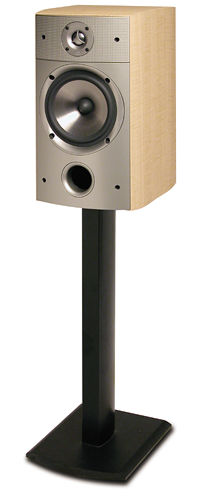 A new Image
PSB's current product line is quite broad, with more than a dozen two-channel products ranging from $199 to $6999/pair. The Images comprise PSB's "mid-priced" line. I was impressed with the least expensive floorstanding Image, the 4T ($649/pair), when I reviewed it for the February 2001 Stereophile. In June 2004, after completely revamping the Image series, PSB sent us the Image B25, at $449/pair the most expensive bookshelf in the current Image lineup.
In my first listening sessions, it soon became apparent that I was hearing several things in the Image B25's midrange that I'd never heard from a bookshelf speaker at this price, or from any PSB speaker at any price. The entire midrange was dead neutral, liquid, and holographic—but when this was combined with an extraordinary level of detail resolution, perfectly articulate transients, and a broad, continuous, organic presentation of the entire dynamic envelope, the overall sonic picture inspired me to strip-mine my music collection for well-recorded acoustic instruments.
A new ImagePSB's current product line is quite broad, with more than a dozen two-channel products ranging from $199 to $6999/pair. The Images comprise PSB's "mid-priced" line. I was impressed with the least expensive floorstanding Image, the 4T ($649/pair), when I reviewed it for the February 2001 Stereophile. In June 2004, after completely revamping the Image series, PSB sent us the Image B25, at $449/pair the most expensive bookshelf in the current Image lineup.
All PSB Image speakers are front-ported, bass-reflex designs that share a new 1", aluminum-dome, ferrofluid-cooled tweeter. The new woofer cones are injection-molded from metalized polypropylene, instead of being vacuum-formed from extruded sheets of the material, as in the original Images. PSB claims that injection-molding results in better consistency. The woofer cones are also of lower mass, for higher efficiency, and have rubber surrounds. Paul Barton told me that he's most excited about the Images' new cabinets, which include a curved "elbow" port tube and strategically placed damping materials, both intended to eliminate "fluting" pipe resonances in the tube.
The Image B25 is a medium-size, two-way, magnetically shielded bookshelf speaker sporting the new tweeter and a single 6.5" woofer. It's designed to perform well on stands or bookshelves, or mounted on a wall as a home theater surround speaker. I set the B25s on my trusty Celestion Si stands, which are loaded with sand and lead shot. (PSB makes its own dedicated stand, the SP-25i, for $99/pair.) My review sample was finished in an attractive light-toned Sienna wood finish; black ash is also available.
Sound
In my first listening sessions, it soon became apparent that I was hearing several things in the Image B25's midrange that I'd never heard from a bookshelf speaker at this price, or from any PSB speaker at any price. The entire midrange was dead neutral, liquid, and holographic—but when this was combined with an extraordinary level of detail resolution, perfectly articulate transients, and a broad, continuous, organic presentation of the entire dynamic envelope, the overall sonic picture inspired me to strip-mine my music collection for well-recorded acoustic instruments.
With the Image B25, I couldn't listen to enough jazz piano. With every original-pressing jazz LP and Acoustic Sounds vinyl reissue I threw at it, the B25 revealed naturally rich and woody piano tones with transient attacks as natural, delicate, articulate, strong, and personal as I've heard from any bookshelf speaker. After spending many hours with Duke Ellington and John Coltrane (LP, Impulse! A-3082), Count Basie's 88 Basie St. (LP, Pablo/Acoustic Sounds 2310-901), Herbie Hancock on Miles Davis' My Funny Valentine (LP, Columbia CL 2306), and Thelonious Monk on Miles and Monk at Newport (LP, Columbia CS 8978), I thought maybe I should listen to something other than piano recordings.
But woodwinds, especially in the lower register, affected me in the same way. Sonny Rollins' natural, breathy, vibrant tenor sax shone on Saxophone Colossus (LP, Prestige/Acoustic Sounds LP-7079), as did the seductive and angular solo-clarinet passages in Kohjiba's Transmigration of the Soul, on Festival (CD, Stereophile STPH007-2). I thought I'd memorized that last piece; but as I reveled in the wide yet subtle dynamic shadings of its marimba passages, I noticed for the first time that the clarinet sometimes doubles the marimba. The same level of detail resolution enabled me to pick out mistakes in some acoustic guitar passages on Janis Ian's Breaking Silence (CD, Analogue Productions CAPP 027), and in Mark Ribot's dobro work on Madeleine Peyroux's Dreamland (CD, Atlantic 82946-2).
The marimba passage in the Kohjiba had shown me how the PSB's articulate resolution of midrange detail extended into pristine, delicate, uncolored, yet unfatiguing high frequencies—and now began my quest for percussion recordings. When I listened to John Cage's Third Construction, from Pulse (LP, New World/Classic NW 519), the Images completely "disappeared," letting me easily follow each percussion line with its sharpness, dynamics, and speed intact, but without a trace of hardness. From my notes on listening to Wuorinen's Ringing Changes (LP, Nonesuch H71263): "master-tape-like dynamics and transients—a veritable window on the chamber orchestra."
After I'd analyzed Max Roach's drum technique on the aforementioned Sonny Rollins LP, I decided to hold a drum master class in my listening room. I'd been raving to a close friend, session drummer Mark Flynn, about the unorthodox and extraordinary drum technique of David King, drummer for The Bad Plus. I decided to showcase King by playing Mark the band's These Are the Vistas (CD, Columbia CK 87040) through the PSBs. King's use of a small, simple Slingerland kit with an intense yet subtly focused snare as the centerpiece, his dynamic use of the ride and sizzle cymbals in what is almost a role reversal of those instruments, and an extraordinarily focused sense of power and energy in all the album's trio arrangements, were all easy to point out to Mark with the B25s
The B25's high-frequency articulation showed up well on the tutti brass passages of the Basie LP as well. The muted trumpets were searing and biting, but not a bit spitty. I noticed a similar effect on the brass passages of my white-dog pressing of Bartók's Concerto for Orchestra (LP, RCA Living Stereo LSC-2643). Moreover, the passages of massed strings in this work were searing yet silky and sweet, as they are in live performances. Finally, the PSBs were capable of a tremendous sense of drama—the high-level passages of this orchestral blockbuster showed no hint of strain or compression throughout the wide, deep soundstage.
I compared the PSB Image B25 ($449/pair) with the Epos ELS3 ($329/pair), the NHT SB-3 ($600/pair), and the Alón (now Nóla) Li'l Rascal Mk.II ($595/pair).
Paul Barton has once again upped the ante on what he can design into an affordable loudspeaker. Although it's been several years since I heard and reviewed his Image 4T, I can't recall a single area where that older, more expensive speaker outperformed the Image B25—it impressed me in many areas and let me down in none. I can't think of a single other speaker for less than $500/pair that outperforms the PSB Image B25. Congratulations, Paul!
The B25's high-frequency resolution was most evident in its rich, natural, liquid rendition of female vocalists. I noticed that all sibilant passages were prominent without being bright, and with levels of articulation and realism and a lack of coagulation reminiscent of the effect of hearing a moving-coil phono cartridge for the first time.
On the opposite end of the frequency spectrum, the B25's bass performance was fairly natural and extended, and capable of high-level dynamic slam and realism. Jerome Harris' bass on "The Mooche," from Editor's Choice (CD, Stereophile STPH016-2), sounded woody, natural, and nonresonant, if a touch warm. On electronic recordings, such as Sade's Love Deluxe (CD, Epic EK 5317), the bass synth and drum machine were extended, powerful, and dynamic. This recording's slight midbass warmth adds to its power and drama; at 95dB volume levels, it shook the house and partied hard, without a trace of overhang or resonance.
Further down the frequency spectrum, the organ pedals on John Rutter's Requiem (CD, Reference RR-57CD) didn't shake the room, but were uncolored and, as my notes read, "damn convincing from a bookshelf." I also noted that the soprano soloist on this recording sounded completely integrated into the acoustic of the recording venue, a church.
I was intrigued by how clearly the B25 revealed the extent to which electronic processing had been used in rock recordings. I noticed, on Sade's Love Deluxe, how subtly and ingeniously gating had been applied to the sound of the drum machine. The PSBs also made very clear how, on Aimee Mann's Bachelor No.2 or The Last Remains of the Dodo (CD, Super Ego SE 002), the engineers had overdone the compression on all of the instruments while leaving Mann's vocals unscathed, which puts the sound of this otherwise excellent recording slightly out of joint.
Competition
I compared the PSB Image B25 ($449/pair) with the Epos ELS3 ($329/pair), the NHT SB-3 ($600/pair), and the Alón (now Nóla) Li'l Rascal Mk.II ($595/pair).
The Epos ELS3 exhibited less midrange detail, as well as less extended and articulate high frequencies, than the PSB. However, the Epos's slightly less liquid and less holographic midrange was very natural, and the speaker presented a somewhat smaller sound. These differences were noticeable but not dramatic. On the low end of the spectrum, bass extension and high-level dynamic slam were almost as good as the PSB's, despite the Epos's significantly smaller size. Still, the PSB exceeded the Epos in high-level dynamic articulation in the midrange and highs.
The NHT SB-3 was very liquid and involving in the midrange and sounded somewhat more romantic, but resolved a bit less detail. The PSB also had more extended and detailed high frequencies. The NHT's bass extension and high-level dynamic slam were equal to the PSB's, though the NHT's midbass was somewhat warmer. Unlike the PSB, the NHT tended to compress the sound a bit on complex passages.
The Li'l Rascal Mk.II exhibited somewhat more detail and air in its liquid-sounding midrange than the PSB, but the PSB's high frequencies seemed more sophisticated, articulate, and revealing. The Li'l Rascal's bass extension and high-level dynamic contrasts were very similar to the PSB's.
Payoff
Paul Barton has once again upped the ante on what he can design into an affordable loudspeaker. Although it's been several years since I heard and reviewed his Image 4T, I can't recall a single area where that older, more expensive speaker outperformed the Image B25—it impressed me in many areas and let me down in none. I can't think of a single other speaker for less than $500/pair that outperforms the PSB Image B25. Congratulations, Paul!