


Tell me now: When you're there in the scene, watching Lord Voldemort chase Han Solo through the Cave of the Klan Bear, how often do you notice that the sounds you're experiencing are being pumped at you from five black-painted room boundaries, while the flickering-light images approach from only one? Moreover, in a parallel, more quotidian reality, you're sitting upright in your seat, noisily chomping popcorn while absorbing—and processing—massive amounts of sensory data: Did you ever consider the sensual, mechanical, and psychological complexity of a moment like this, and how fundamentally unnatural it is?
I must start by introducing Aleksandar Radisavljević. He's the founder and chief engineer of Serbian manufacturing company RAAL Advanced Loudspeakers, established in 1995, which manufactures a range of dipole ribbon tweeters (footnote 1). Aleksandar is also co-founder and director of R&D and manufacturing for Requisite Audio Engineering of Ventura, California, which is responsible for the creation of the RAAL-Requisite SR1a ribbon headphones, which the company describes with the trademarked descriptor "Earfield Monitors."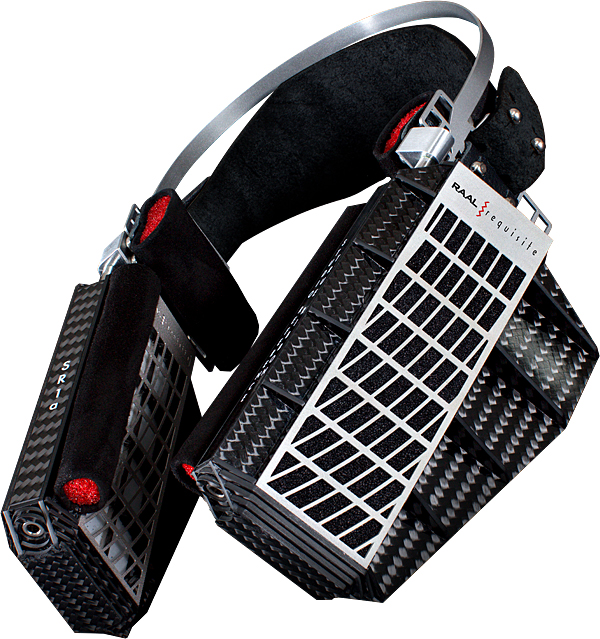
Beyond their unprecedented full-range ribbon-ness, the RAAL-Requisite SR1a headphones are distinguished by their off-the-ear-ness. This is important: It means their sound character is not manufactured or controlled by a circular padded acoustical chamber surrounding the listener's pinna—like virtually all other over-ear headsets. This is important because all circumaural over-ear headphones have one unsubtle, unnatural, and unavoidable listening component: They mechanically cup our ears, and we can feel them doing this cupping the whole time they're on our heads. (If you cup your hands right now and place them snugly over your ears, you'll experience the resonant seashell-like sounds that result from this cupping.) This air-tight pressurizing is also called "chambering," which is how over-ear headphones make bass. The problem is, this audible circumaural cupping and chambering mask detail and compress lower frequencies.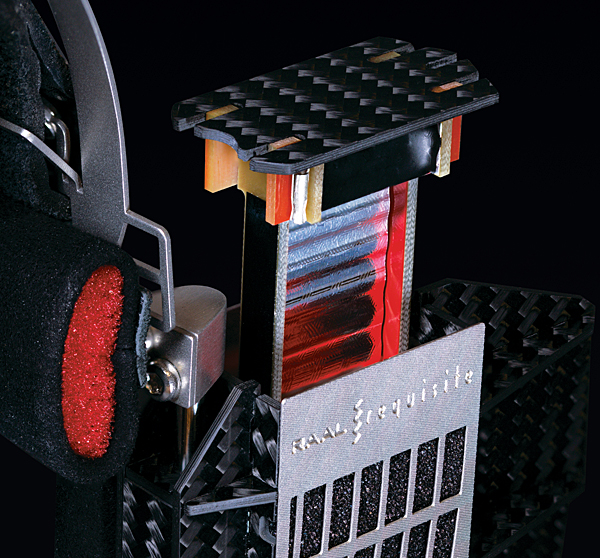
Aleksandar Radisavljević explains why the SR1a headphones need a 100Wpc amp:
Footnote 1: RAAL Advanced Loudspeakers d.o.o., Djordja Simeonovica, 419000 Zajecar, Serbia. Tel: (381) 64 144 1111. Web: raalrequisite.com, raalribbon.com. Requisite Audio Engineering, 2175 Goodyear Ave, Suite 110, Ventura, CA 93003-7761. Tel: (818) 437-0779. Web: requisiteaudio.com.
What I love most about cinema is how easily and effectively my brain lets me experience being there in the bed with Brigitte Bardot in Les Femmes (1969), or there on the platform of the train depot during the opening sequence of Once Upon a Time in the West (1968). My memories of both places remain vivid.
I confess, I do not understand how my mind can convert marginally realistic sounds and two-dimensional flickering-light images into me being somewhere else. But I do have this memory of my 3-year-old daughter putting a cookie in the door of our VHS player. When I asked her why she did that, she looked at me and said, with absolute matter-of-factness, "I'm feeding the Little Mermaid." It was then I realized: We are wired from an early age to assemble extremely abstract data into powerful conscious realities. This reality-forming process appears to function pretty well no matter how unnatural or abstracted the data it's working with.
Whether I'm reading a book, watching a movie, or listening to music files, the success of my brain's reality-construction depends not on the quantity or quality of data, but instead on my ability to focus my attention on the data as it is presented. The more complete my focus, the more complete my experience of a constructed reality.
I remember my college anthropology teacher explaining how, almost a century ago, explorers filmed a tribe of indigenous Melanesians. When they projected the moving images on a screen, no one in the tribe recognized the chief or his wife or anything that resembled their world. Why? Because they had not yet learned to decode the pictographic language of cinema. Because they had never fed the Little Mermaid.
And of course being an audiophile means I've spent my life staring at an equipment rack between a pair of wood boxes—watching whole operas, Horowitz at Carnegie Hall, or a sweaty Tina Turner singing "Proud Mary." I saw all this because I've spent a lifetime learning to "see" musicians both inside and outside the speaker boxes.
All this cranial-nerve anthropology brings me to the chief question of this column: Is listening to music with headphones really more difficult or "unnatural" than reading a book? Watching a movie on a flat screen? Or staring at the space between wood boxes? Or rather: Is the art of headphone listening something many audiophiles of a certain age have never learned to do—like Gen Z never learned to sit in a sweet spot staring between giant speakers? Well folks, it's never too late for old dogs, because I'm pretty sure I've found a unique non-headphone headphone—one that will instantly satisfy both headphone connoisseurs and stubborn contrarians: the RAAL-Requisite SR1a's ($3499). These radical high-tech contraptions sit lightly on your head and neither cover your ears nor put pressure on your pinna. Plus! They image outside and away from your skull—similar to floorspeakers!
Are you ready?
RAAL-Requisite SR1a headphones
I must start by introducing Aleksandar Radisavljević. He's the founder and chief engineer of Serbian manufacturing company RAAL Advanced Loudspeakers, established in 1995, which manufactures a range of dipole ribbon tweeters (footnote 1). Aleksandar is also co-founder and director of R&D and manufacturing for Requisite Audio Engineering of Ventura, California, which is responsible for the creation of the RAAL-Requisite SR1a ribbon headphones, which the company describes with the trademarked descriptor "Earfield Monitors."
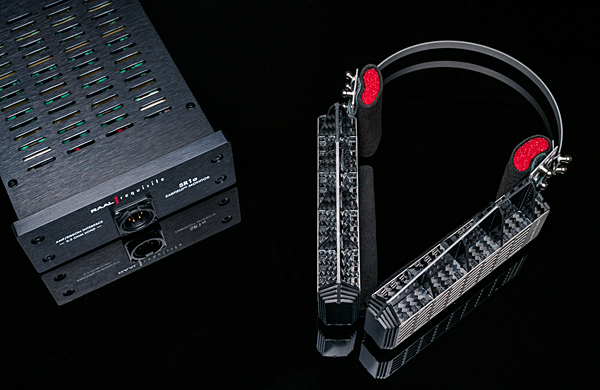
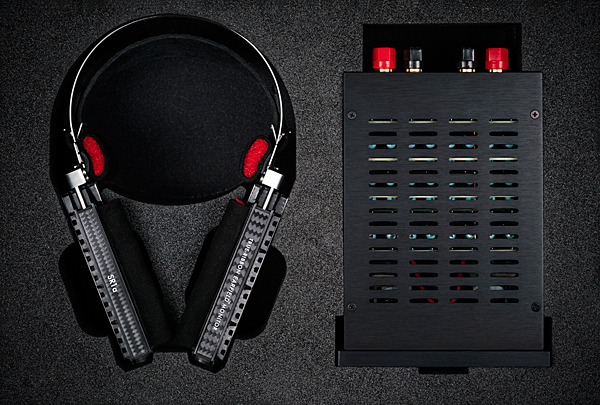
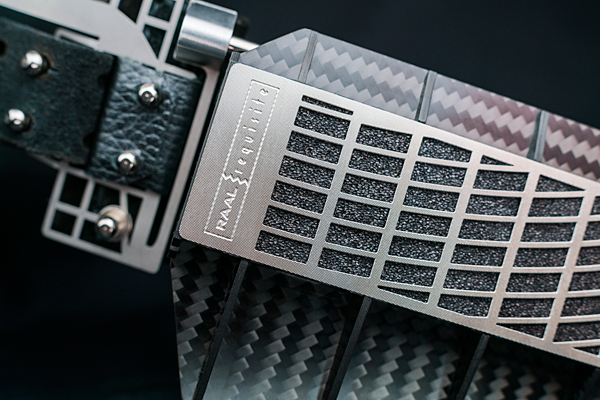
To the best of my knowledge, the RAAL SR1a's contain the world's first and only full-range, pure-ribbon drive-units. To qualify as a pure ribbon, the diaphragm must be a thin, rectangular strip of metal foil, attached only at its narrow ends and energized by rows of permanent magnets at its sides. The diaphragm of a pure ribbon is not attached to a film substrate, as with Magnepan's quasi-ribbons or various manufacturers' air-motion transformer tweeters. The SR1a's design aesthetic relies heavily on laser-cut stainless-steel rectangles and thick buffalo leather. To situate the RAALs properly on my head, I needed to adjust the length of the broad leather top band and the narrower leather back-of-head band. These two bands combine to center the twin 3.77" × 0.75" (95mm × 19mm) open-baffle ribbon-drivers on the entrance to my ear canals.
Along the front edge of each SR1a baffle is a 0.65" × 4" roll of red-orange memory foam wrapped in Italian lambskin suede. That foam-and-suede roll keeps the SR1a off the head and away from the ears. The back part of each earpiece features a gusseted pentagonal wing made of what appears to be lenticular gray-black carbon fiber. That "wing" serves as a waveguide while increasing the area of the ribbon's baffle, allowing for deeper bass.
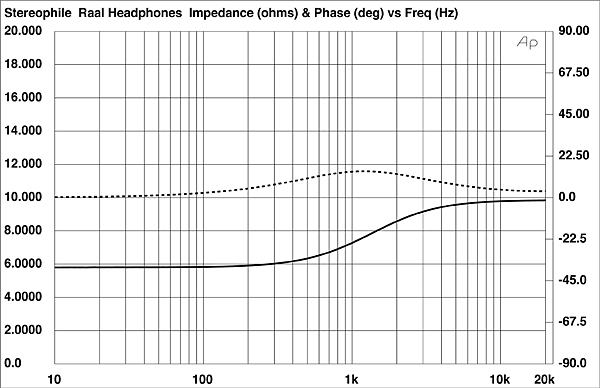
The SR1a's weigh 15oz (425gm) and come packed in a Pelican case. The RAAL ribbon's natural impedance is a near-dead-short 0.018 ohm. Therefore, they need to be driven by a 50–150Wpc loudspeaker power amplifier (not included) via an impedance-matching interface box (included). This 2" × 5" × 7" ventilated black box contains banks of power resistors that bring the SR1a's apparent load up to approximately 6 ohms (fig.1, footnote 2). The output of this interface box must be connected to the SR1a headset via a 7' Y-cable with a female XLR connector (use of which prevents the owner from accidentally connecting the RAAL headphones directly to the output of a headphone amp, with guaranteed bad results). Also included are two 2' pairs of banana-to-banana cables for connecting the output of your power amplifier to the input of the interface box.
Fig.1 RAAL-Requisite SR1a headphones, electrical impedance (solid) and phase (dashed) (2 ohms/vertical div.).
The RAAL-Requisite SR1a's, which come with a 5-year warranty, are not only the world's first full-range pure-ribbon transducer; as far as I know they are also the world's first headphones that are repairable by the user. The SR1a ribbon drivers are encased in a unique "cartridge" that simply slides in and out of the headphone shell. No tools are required, it takes just a few minutes, and electrical contact is made automatically. These field-replaceable ribbon cartridges cost $199 each or $350/pair.
Cupping and chambering
Beyond their unprecedented full-range ribbon-ness, the RAAL-Requisite SR1a headphones are distinguished by their off-the-ear-ness. This is important: It means their sound character is not manufactured or controlled by a circular padded acoustical chamber surrounding the listener's pinna—like virtually all other over-ear headsets. This is important because all circumaural over-ear headphones have one unsubtle, unnatural, and unavoidable listening component: They mechanically cup our ears, and we can feel them doing this cupping the whole time they're on our heads. (If you cup your hands right now and place them snugly over your ears, you'll experience the resonant seashell-like sounds that result from this cupping.) This air-tight pressurizing is also called "chambering," which is how over-ear headphones make bass. The problem is, this audible circumaural cupping and chambering mask detail and compress lower frequencies.
Cupping is what tells my brain that sound is being pressured into my ear canals. Even when I close my eyes, my awareness of cupping shuts me in and encourages me to imagine the band is playing inside my head. (Headphone-haters hate when that happens.)
Off-the-ear headphones like the RAAL-Requisite SR1a's and the JPS Labs Abyss AB-1266 Phi's do not cup or chamber: Instead, they hover near the listener's ear, which means they deliver free and open reproduction that requires very little brainwork to reconstruct.
Amp requirements
Aleksandar Radisavljević explains why the SR1a headphones need a 100Wpc amp:
"Since there is already a 10:1 (or higher) ratio of cable to ribbon resistance, this means that the ribbon will not be controlled by amplifier damping. (It was clear from the beginning that ribbon excursion and damping control must be accomplished by passive means: using small amounts of acoustical resistance.)
Footnote 1: RAAL Advanced Loudspeakers d.o.o., Djordja Simeonovica, 419000 Zajecar, Serbia. Tel: (381) 64 144 1111. Web: raalrequisite.com, raalribbon.com. Requisite Audio Engineering, 2175 Goodyear Ave, Suite 110, Ventura, CA 93003-7761. Tel: (818) 437-0779. Web: requisiteaudio.com.
Footnote 2: Using the Dayton Audio DATS V2 system, John Atkinson measured the impedance magnitude and electrical phase angle of the RAAL headphones with them plugged into their adapter box. The load seen by the amplifier varies between 5.8 ohms below 300Hz and 9.8 ohms in the high treble. It is almost a pure resistance, however, the phase angle measuring close to 0° across the audioband.
"Since the amplifier damping factor plays no role and the cables need to be terminated with more than 2 ohms, then we can use a resistor of any convenient value connected in series to the headphones and their cable. As far as the ribbon is concerned, this is a current-source operation mode.
Schiit's new $799 Aegir amplifier generates 10Wpc in class-A and 20Wpc in Schiit's proprietary Continuity bias. It is lower-powered than the RAAL-Requisite headphones require, but it is my current reference for high-quality solid-state power at a low price. It is also my current favorite headphone amp. Not surprisingly then, it is the first amp I used with the SR1a's.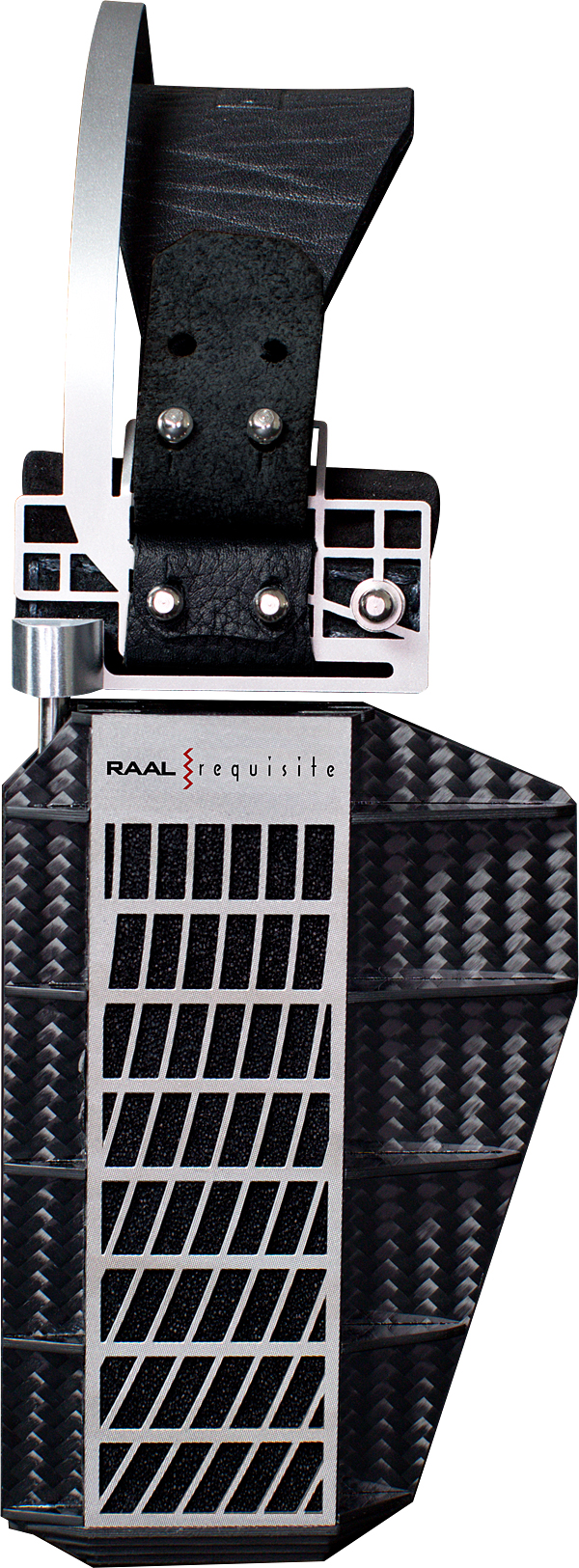
If you want to hear what your amp really sounds like, or everything your expensive phono cartridge is recovering, or how different all your DAC's filters sound, you need a head-mounted transducer that resolves at the level of the RAAL SR1a, coupled to the class-A Pass Labs XA25 stereo amplifier, which is definitely more powerful than its modest 25Wpc into 8 ohms and 50Wpc into 4 ohms ratings suggest. No matter what hi-fi you have, it's unlikely to dig deeper and find more beauty in your recordings than the RAAL-Requisite SR1a's connected to this extraordinary design. I experienced no current shortages, and Vladimir Horowitz's piano sounded richer and more solid than ever.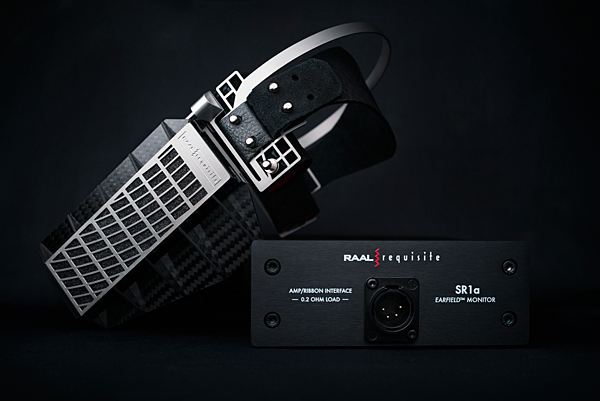
The Schiit Aegir demonstrated that the RAAL ribbons were highly resolving. The Pass Labs amp took said resolution and transparency to the next higher level, and added more physical weight to the presentation. But both amplifiers are under 100Wpc. So I decided to try a more powerful amplifier, one that many people recommend for the SR1a headphones: Benchmark's AHB2 stereo amp. The AHB2 is famous for its low measured distortion, low output impedance, and high damping factor.
I tried the RAAL SR1a's with only one tube amp: Rogue Audio's 100Wpc Stereo 100. It sounded okay, but the amp clipped easily and often. That discouraged me from trying any other tube amplifiers.
Q: Are the $3500 SR1a's better than the $4999 Abyss AB-1266 Phi's?
Three types of audiophiles will appreciate the RAAL-Requisite SR1a's:
"The RAAL specs say: Impedance: 0.018 ohms; Sensitivity: 85dB/1mW; Power Handling With Bass-Heavy Tracks: 450mW RMS; Max SPL at 450mW RMS (limited by ribbon excursion at LF): 111dB.
"To develop 450mW of power at 0.018 ohms load, we need 5 amps RMS."
Listening with the Schiit Aegir
Schiit's new $799 Aegir amplifier generates 10Wpc in class-A and 20Wpc in Schiit's proprietary Continuity bias. It is lower-powered than the RAAL-Requisite headphones require, but it is my current reference for high-quality solid-state power at a low price. It is also my current favorite headphone amp. Not surprisingly then, it is the first amp I used with the SR1a's.
With moderate musical program at moderate volume levels, I did not notice any power limitations—only clear, liquid, elegant sound. The sound of Vladimir Horowitz's piano on Horowitz the Poet (44.1/16 FLAC, Deutsche Grammophon/Qobuz) flowed naturally and emitted all the coded data my brain needed to forget hi-fi, headphones, and audio journalism. Vlad's piano sounded true of tone—like it should always sound. Enjoyability level was high.
Listening to this record was the first time I felt I had the SR1a's positioned perfectly relative to my pinna. Because the RAALs sit away from my skull, and because the carbon fiber "baffles" are adjustable, it took me a couple of days to get the bass vs space ratio dialed in. As always, when Horowitz sounds right, I know my system is right.
With the Schiit Aegir, the RAAL-Requisite headphones' greatest virtue became obvious: They did not sound like any circumaural headphone or in-ear monitor I know of. With their extreme purity and resolution, the SR1a's deposited Vladimir Horowitz, his piano, and the room he was playing in right there, in the space in front of me. Not inside my skull.
Everyone knows I'm a devotee of small, monitor-type speakers listened to in the extreme nearfield—wherein they play big. And the RAALs are just that: They are, unquestionably, small monitor-like speakers that play big when listened to from about 0.75" from my ear. What more could I want?
The words "whole" and "resolved" acquired new meaning as I listened to my favorite test track: "Buddy & Maria Elena Talking in Apartment" from Buddy Holly's Down the Line: Rarities (CD, Decca B001 1675-02). More than ever before, I felt like I was in a real apartment (not in my head) hearing two people sound like themselves, saying real-life things. Think high resolution and natural at the same time—not hi-fi.
That being said, when I turned the volume up on "Love Is Strange," the Aegir made a few crunchy clipping sounds. The RAALs were demanding more current than the Schiit could deliver.
Listening with the Pass Labs XA25
If you want to hear what your amp really sounds like, or everything your expensive phono cartridge is recovering, or how different all your DAC's filters sound, you need a head-mounted transducer that resolves at the level of the RAAL SR1a, coupled to the class-A Pass Labs XA25 stereo amplifier, which is definitely more powerful than its modest 25Wpc into 8 ohms and 50Wpc into 4 ohms ratings suggest. No matter what hi-fi you have, it's unlikely to dig deeper and find more beauty in your recordings than the RAAL-Requisite SR1a's connected to this extraordinary design. I experienced no current shortages, and Vladimir Horowitz's piano sounded richer and more solid than ever.
The Nelson Pass–designed amp made the Aleksandar Radisavljević–designed ribbons sound absolutely pure and relaxed with not even a hint of glare on sopranos or massed strings.
On viola da gamba virtuoso Hille Perl's Loves Alchymie (44.1/16 FLAC, Deutsche Harmonia Mundi/Tidal), when soprano Dorothee Mields speaks these words from John Donne's poem The Bait—"Come live with me and be my love / And we will some new pleasures prove"—I could hear each word bounce off the church walls. Her voice was framed in seductive pulsing reverberation. The experience made me grateful to be an audiophile and to have discovered this beautiful, enchanting album.
Best of all, on this recording, the RAALs showcased their most engaging virtue: material presence. Hille Perl's viola da gamba appeared in full, tangible materiality. Her instrument had bite and weight and emitted the sounds of ancient wood. Perl's bow strings felt more like horsehair than they had with any other headphones in my possession.
Listening with the Benchmark AHB2
The Schiit Aegir demonstrated that the RAAL ribbons were highly resolving. The Pass Labs amp took said resolution and transparency to the next higher level, and added more physical weight to the presentation. But both amplifiers are under 100Wpc. So I decided to try a more powerful amplifier, one that many people recommend for the SR1a headphones: Benchmark's AHB2 stereo amp. The AHB2 is famous for its low measured distortion, low output impedance, and high damping factor.
According to the Benchmark manual, the AHB2 combines a class-H power supply and class-AB amplifier technologies with feed-forward error correction. Most important, the Benchmark amp is specified to deliver greater than 29A into 1 ohm (!) and 80V peak-to-peak into any load. The manual says it can put 130Wpc into 6 ohm loads such as the RAAL SR1a.
The AHB2 drove the RAAL ribbons with authoritative clarity. Playing "Cet Enfant-là" from Alexandre Tharaud's Barbara (44.1/24 FLAC, Erato Warner Classic/Qobuz), I experienced an avalanche of previously unheard inner detail. The AHB2 made the SR1a's feel like an aural microscope. The sound was unabashedly clear and well-sorted, but it was also brittle and bright on the Horowitz and Hille Perl recordings.
During parts of Jean-Louis Aubert's vocals (on Barbara), this brightness would sporadically flash my ears with a distracting glare (between 1kHz–3kHz). This reoccurring glare compelled me to turn the volume down. Tharaud's piano appeared enjoyably percussive, but its normally saturated tone was now lightly and evenly bleached. The spit and wet throat were missing from Aubert's vocals. The sensual pleasures of "Poème Vivant" were abridged.
Nevertheless, I understood why so many engineering types would choose the AHB2 with the SR1a's: It played superclear, dug deep, and recovered much.
Listening with the Rogue Audio Stereo 100
I tried the RAAL SR1a's with only one tube amp: Rogue Audio's 100Wpc Stereo 100. It sounded okay, but the amp clipped easily and often. That discouraged me from trying any other tube amplifiers.
Important comparisons
Q: Are the $3500 SR1a's better than the $4999 Abyss AB-1266 Phi's?
A: No.
But they are not inferior.
The Abyss AB-1266 Phi's remain my reference headphones. When powered by the Pass Labs XA25 amplifier, the Abyss 'phones deliver the most natural, lifelike audio reproduction I have experienced. The Abyss headphones are also quieter and more transparent than the SR1a's.
Like the SR1a's, the AB-1266 Phi's sit off the ear, but only far enough to not cup or chamber. The SR1a's sit farther off the ear and, consequently, let in more room sound. This added openness is a pleasure to experience—especially the imaging. But said openness automatically reduces quietude and transparency.
The sonic landscape of the Abyss AB-1266 Phi's is liquid and silent, like its namesake. Like the ocean's depths, the Abyss 'phones showcase a shadowy transparency. In stark contrast, the SR1a's exhibit a hazy, bright-sun transparency. The RAAL-Requisites are more conspicuously open and dynamic than the Abyss 'phones. But . . .
Please understand . . . the Abyss and RAAL headphones sound more alike than they sound like any other headphones out there. Both headphones exist on the leading edge of transducer science. Their only competition (in my limited experience) is the HiFiMan Susvara headphones.
Q: Are the RAAL SR1a ribbons better than the HiFiMan Susvaras?
A: Maybe a little.
As I switch from the completely open SR1a's to the merely open AB-1266 Phi's to the not-very-open (circumaural) HiFiMan Susvaras, the sonic landscape becomes more closed in. With the Susvaras, I can definitely hear that cupping-induced seashell reverb I described at the beginning.
Conclusions
Three types of audiophiles will appreciate the RAAL-Requisite SR1a's:
The first are seasoned headphone connoisseurs who have been in the game a while and already own a collection of venerable exotics like Sony's MDR-R10 and Qualia 010, AKG's K1000, and Grado's original RS1. These listeners are confirmed aficionados seeking to experience recordings with the greatest amount of verity . . . and (!) that extra special lightning-in-a-bottle something that raises a headphone above the herd of its time. For these audiophiles, the RAAL-Requisite SR1a's will be a must-have addition to their collection.
The second are crotchety audiophiles who detest headphone listening, declaring it "unnatural!" These headphone holdouts will love and embrace the RAAL-Requisite SR1a. They will be astonished (and feel validated) by how much the SR1a's sound like regular sit-on-the-floor loudspeakers.
The third are mastering engineers. My friend Frank Schröder, the renowned German tonearm designer, was the person who turned me on to the RAAL-Requisite ribbons. He loaned me his pair while he visited NYC. Frank said he used the SR1a's to master recordings, and sure enough, I discovered that Aleksandar Radisavljević designed them with that use in mind. No question, they are revealing enough for the job.
In my view: The RAAL-Requisite SR1a's are both revelatory and revolutionary. Class A+.