


Frankly it's a bit nutty for me to be doing this review. First, as Publisher of this esteemed journal, my primary duties involve financial and personnel management, as well as a good bit of public relations; I don't need and am not required to perform the exacting tedium of product reviews. Second, Jim Thiel and Kathy Gornik of Thiel are friends of mine. So what, you ask? Well, if this were going to be a uniformly positive review, I would therefore be ruled out as the reviewer; if it's to be wholly or partially negative, it will surely put a strain on one of my best audio friendships.
 But wait—that's where I disagree. Although it's rarely seen as such by product designers—and even less often by those in charge of sales—the critical reviewer performs a dual function: For the magazine's reader, he or she evaluates, informs, and aids in the buying decision; for the product's creator, he offers insight into the response of the typical buyer and possibly saves the embarrassment of a flawed product design. This last benefit, of course, presumes that the reviewer is better able to perceive the product in a typical use situation than is the designer. It is on the correctness of just this presumption that we hang our hat(s).
You'll be relieved to hear that my discussion of the CS3.5 will be shorter than that of the CS1.2 and CS2—primarily because most of what needs to be said has already been said, and more recently too.
But wait—that's where I disagree. Although it's rarely seen as such by product designers—and even less often by those in charge of sales—the critical reviewer performs a dual function: For the magazine's reader, he or she evaluates, informs, and aids in the buying decision; for the product's creator, he offers insight into the response of the typical buyer and possibly saves the embarrassment of a flawed product design. This last benefit, of course, presumes that the reviewer is better able to perceive the product in a typical use situation than is the designer. It is on the correctness of just this presumption that we hang our hat(s).
Wait a minute yourself, I can hear you saying. "The alleged achievement of objectivity aside, why should we pay any attention to what you say, LA? You haven't appeared in print (aside from your monthly 'Final Word' column—which we hear, by the way, arrives at the printer just before plate meets paper) since Vol.7 No.3, way back in 1984." Recognizing the justice of this question, and in place of a more comprehensive "Matter of Taste" (to appear in a future issue), I herein plead my case.
My musical and equipment tastes have already received some attention from time to time in these pages, in both my own comments and in those of others (primarily JA). My musical tastes are catholic in the extreme: raised on the classics, I fell in love with folk music at an early age, became enamored of what's now called soul while still in my teens (in the best place for it—the Mississippi Delta), was forced to accept Romantic sonorities by JGH, listen to C&W sometimes, like Gospel, look back nostalgically on musicians as completely in synch with their times as the Beatles, have been acclimated to hard rock (from the 1970s primarily) by JA—and even have had to say a good word about Wagner, at RL's prompting.
I listen in an unusual room, 20' by 35' with an 11' ceiling—almost 8000 cubic feet. Although heavily carpeted and furnitured, the room is not at all dead—not nearly dead enough for JGH, who is, for my tastes, too accustomed to his Tube Traps. Amplification for this review was provided by Mark Levinson, in the form of the Nos.26 and 20. Source material was analog LP (no digital-to-analogs, thank you) played on a Well-Tempered Turntable and Tonearm (the best value ever in a $1000–2000 'table-plus-tonearm, in my opinion) with a variety of cartridges, none of them spectacular. Interconnects varied, but tended toward the "lean and clean" school, as exemplified by Straight Wire, Discrete Technology, and Audioquest. Speaker cabling was the super-exotic Kimber 4AG recommended by DO in Vol.11 No.7. Also included was CD listening, on both the Denon DCD-3300/DAP-5500 combo and the CAL Tempest II.
Attuned readers know that I fall into the digiphobe category, though not unreasonably I hope. Well, the Tempest II is almost enough to get me out. It adds to the convenience inherent to CD—and I don't care what machine you use, they're all a helluva lot easier than even a B&O record player—an ease of listening that's very tempting. Only when ultimate transparency and that "see-into" quality are necessary, or the ultimate performances which in my experience are found only on LP, is LP the only answer. Still, that's most of the time, especially when you're reviewing equipment.
But In the end I must win you over with the cogency of my argument and the correctness of my observations; you alone will be the judge. After this much hot air, on with the review.
Thiel CS3.5: $2450/pair
You'll be relieved to hear that my discussion of the CS3.5 will be shorter than that of the CS1.2 and CS2—primarily because most of what needs to be said has already been said, and more recently too.
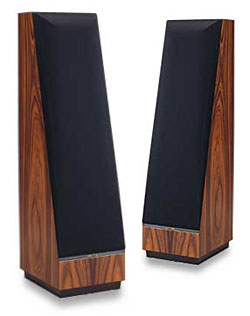
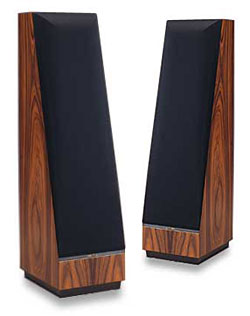
Were I to say that the '3.5 is simply a bigger version of the '2, I wouldn't be too far off. It weighs 15 lbs more per speaker, goes significantly deeper in the bass, and will play louder. Were you to see a pair of '3.5s in one store and '2s a few weeks later in another store, you could be forgiven for thinking they were the same product. (Thiel has kindly put different finishes on my different pairs so I don't fall into the same confusion.) The typical Thiel attention to finish quality is present here to the same degree, and the gently tapering front panel as well.
With the '3.5 (which followed the CS2 by nearly a year and a half) Thiel has incorporated the anti-diffractive front-panel effects, which appear to me to be more through-going than on the CS2, into the baffle itself, rather than relying on the grille. You may therefore use them without grilles, as I have, particularly if you find the front-panel contouring attractive.
The '3.5 and '2 have similar tweeters, and their upper-range behavior is, not surprisingly, just about identical. The midrange drivers are different, though, with the one on the '3.5 appearing to me to be much the heavier-duty, with a substantially larger magnet. Although their power-handling capabilities have been in my experience about the same—both were plagued by failure in response to upper-bass and lower-midrange transients—I suspect that on the '3.5 I was led to play the speaker louder because of its overall greater loudness capability.
More important, though, the CS3.5 has never suffered from the upper-midrange problem of the CS2. While preserving the general forward character typical of all Thiels, and their extended high frequencies, the '3.5 is more "generous" than the '2; it lets you get away with more. I should emphasize that I have still never heard it sound good with anything but superbly clean electronics, but it has not demonstrated the same lack of affection for CD that I found with the earlier '2s. (I've demonstrated that lack, but not the speaker.)
The biggest difference between the '3.5 and the '2, however, is in the bass. The '3.5 is a sealed box, has a woofer with 65% more radiating area, and uses a custom equalizer, made for insertion between pre- and power amp or in a tape loop, to modify the low-frequency response. This is claimed to yield flat response down to 22Hz, which JA and I confirmed when we were attempting to deal with Bud Fried's accusations about our supposedly screwed-up measuring techniques when reviewing the Fried G/3. (It turned out we had been right; in my listening room, the G/3 rolled off below 40Hz, being 9dB down at 31.5Hz and –18dB at 20Hz, while the Thiel was flat to 22Hz.) But from a measurement standpoint, the '3.5 has not pulled a rabbit out of a hat; we observed significantly high distortion from the Thiel's woofer when reproducing the range below 35Hz at 90dB.
Tonal Balance: As in physical size, with the '3.5 you get a bigger sound than from the CS2. This is true even without the equalizer; with the equalizer, you get an overall sound that suffers, as far as size is concerned, in comparison only with live music (which can be so much bigger than anything heard reproduced that I wonder we make the comparison) and much bigger, more expensive speakers. (The Vandersteen 4As, the Apogee Divas, the Sound Labs, the Duntechs, IRS Betas and Vs, and WAMMs come to mind. Interestingly, JA's Celestion SL700s, under the right circumstances and in his room, can just about match the Thiels.)
This is due to bass extension, loudness capability, and the generosity I referred to above. At the same time, the blending of drivers is just as good as with the CS2, and with greater difficulty since a significantly larger range is being covered.
Putting a line-level equalizer in a high-end speaker is like waving a red flag in front of the audiophile crowd, both press and consumer alike. My response is a bit complicated.
Perhaps my focus on the "problem" in the CS2, now essentially cured, led me to pay inadequate attention to the high-frequency behavior of this tweeter. Its response is essentially flat out to 35kHz (according to information from Thiel), and sounds that way. The upper harmonics of triangle and cymbals are preserved with excellent detail. If I could make a criticism, it would be that as a listener you are made too aware of high-frequency information. This is certainly equipment-dependent. Use anything in the neighborhood of a typically transistory amplifier and you will be driven from the room. Use an old-fashioned tube amp and you will essentially be throwing away the upper range of the tweeter; something in between—a forgiving transistor product, such as the Levinson '20, or an extended tube product, such as the VTL—is called for here.
But the situation—I don't know whether to go so far as to call it a problem—is not simply a matter of level or of accurate reproduction of an inaccurate input signal. Although I don't hear from this tweeter what JA refers to as typical soft-dome spittiness, I do feel there is a mild amount of "splash," where high-frequency transients are spread out in time just a bit, which makes them more apparent than they should be. They don't disappear quite quickly enough, as they do, for instance, on Gordon's Sound Labs or with the Magnepan ribbon. I am not as much of an enthusiast about metal-dome tweeters as some, though the best of them offer very clear advantages over all but the best alternatives in soft-dome tweeters. I'm unconvinced that simple substitution of the metal-dome unit that Monitor Audio uses, for instance, would better the performance of the '3.5, but I do know that it could be improved in this area. I offer this criticism partially to you as users of the '3.5s, so you can carefully match your associated equipment; I also offer it to Jim Thiel as my idea of where his future designs can go.
As would be implied by the flat-to-22Hz spec, the '3.5s are truly impressive at the low end. I would tend to characterize this advantage, though, as one of ease rather than range, and it is true only within some limitations. By ease, I mean that program material without much very low information—which characterizes most orchestral music—doesn't really sound different in terms of tonal balance, but it happens more easily. On the odd occasion that something low turns up, you experience no anxiety and no sense of loss. The limitations have to do with volume. If you want to hear a really loud bass drum, say at 100dB, or a tremendous orchestral crash, the '3.5 runs up against its stops. You will hear it, but there will be strain. Much larger speakers are necessary for this kind of performance with ease.
As far as low end is concerned, the advantage conferred by the equalizer (outside of certain organ and kick-drum fundamentals, which simply aren't there without it) is much more information about the hall character—a kind of "rounding out" of the performing space—and more body to low-sounding instruments: tympani, for instance, or low orchestral strings. There is a significant amount of music, particularly that recorded in a dry acoustic, where inserting the equalizer makes little low-end difference.
Ambience and Soundstage Retrieval: I mentioned above that defining the size and character of the soundstage was one of the places where the CS3.5 betters the '2; it also betters most other speakers in this regard. I think this is due both to better low-frequency extension and to the increased phase coherence of the sealed-box design. If the low-frequency rolloff of the "natural" '3.5 woofer is minimum-phase, which it theoretically is (though I don't believe that complex electromechanical devices ever respond this simply), then the equalizer's effect should be both flat frequency and phase response. In any case, the '3.5's soundstage integrity is excellent.
With respect to the preservation of individual ambiences, direct comparison between the '3.5 and the latest '2s now tells me that perhaps Thiel has done something with the '2 that he would do well to transfer to the '3.5, if possible. The '2 may now be better, though the difference is small, and it would definitely not be sufficient reason to choose the '2 over the '3.5. The '2 practically commands you to pay attention to the space around the performers; with the '3.5, it's just there.
Dynamics: I'm feeling like a broken record, but with the '3.5 you can take my comments about the '2, and simply increase the range by 4–5dB. This is not an insignificant change, however. Now you can listen to orchestral climaxes at levels I would call quite loud; now there are far fewer selections where you feel any limitation. At the same time, Thiel is able to preserve the sonic character of the speaker over the dynamic range. Perhaps you begin to feel a bit of anxiety in the 96–100dB output range, but not much.
This is not to say that dynamics are an area where Jim Thiel can afford to relax in his top-of-the-line product, nor is he. For more than the last year he has been working on the CS5, the "see God" speaker I referred to in a Show report back in 1986. (This odd expression derives from Jim's encounter with one of his dealers who, though happy to sell the '3.5, demanded that Jim work on a product which would "enable me to see God.") One of the CS5's features will be, I think, four woofers of the same approximate size as the '3.5's, but of custom design. I see two challenges for Thiel: manage to retain the phase and tonal balance coherence of his current designs in a speaker that features both multiple drivers and very high output capability (approx. 115dB); and take advantage of this design effort by bringing down to at least the '3.5 the fruits of his efforts, to give it still greater dynamic capability.
This may sound like I'm happy with the '3.5, but can't be pleased entirely—which is true. I think the '3.5 can become a better speaker; a more relaxed dynamic (together with an ultimate tweeter) is the place I'd start.
The Equalizer
Putting a line-level equalizer in a high-end speaker is like waving a red flag in front of the audiophile crowd, both press and consumer alike. My response is a bit complicated.
Overall, I have to say that I wish the '3.5 didn't have an equalizer, but retained the satisfying low end the equalizer provides. Part of this certainly stems from prejudice, part from rationality (after all, if I'm unhappy with phono-only preamps that cost less than $1500—half of which are simply equalizers—how can Jim Thiel do one for what must be only a few hundred dollars?), but part of it is a subtle feeling that all is not as well as without the equalizer. Initial listening tests of the equalizer in-circuit and out-of-circuit using the Levinson 26's tape loop led to a null result. I still retained my subtle residual dissatisfaction with the equalizer, but would have been loath to outright condemn it. Further listening on the eve of this writing, though, made it a bit clearer.
Using fairly high-frequency sinewaves (up to 10kHz), I heard some minor alteration of pitch with the equalizer in-circuit, usually a sharpening of pitch, but this would vary with the test tone, and even seemed to vary with whether I was listening on- or off-axis to the tweeter. (Lower test tones made the equalizer easy to hear, because of the bass boost; pink noise was the easiest.) My guess is that 2–10kHz squarewaves would be the best test signal for "hearing" the equalizer, but I didn't have them. On music, the difference could be heard, on occasion, as a slight sharpening of high-frequency tones, almost as if there was a little additional spike added to the spikier sounds. Much music is inappropriate for detecting this difference—which means that the equalizer is innocuous in its HF performance on much music. With other pieces, though, you had to choose between optimum high-frequency naturalness (no equalizer) and optimum hall sound or orchestral fullness (equalizer in).
What should you make of my vague preference for the non-equalized state? Well, choose one of three reasons given above, or listen for yourself. My resolution is to put the equalizer in a tape loop and experiment. In your system or to your ears the equalizer may be completely tame; if so, use it without reservation. Otherwise, use it where it makes the music better. I should add that certainly some of the difference I hear is due to interconnects and the tape loop of the No.26; nevertheless, everyone will have to use interconnects with this device, and mine weren't bad (Levinson and Magnan).
Overall, I have to conclude that the '3.5 is better with the equalizer. I just wish the equalizer itself were a bit cleaner, would let more of the music through; I think it needs to be as good as the electronics probably used in the system: Levinson, Threshold, Krell, Audio Research.
Summary
The Thiel CS3.5 is clearly Thiel's best product to date. It is also their best seller, in spite of costing 50% more than the next closest model. If you value the Thiel attention to finish quality and customer satisfaction, and are in sympathy with the Thiel general philosophy about sonic values—neutral, flat frequency response, excellent preservation of soundstage and ambience—the '3.5 is an easy choice
The Thiel CS3.5 is clearly Thiel's best product to date. It is also their best seller, in spite of costing 50% more than the next closest model. If you value the Thiel attention to finish quality and customer satisfaction, and are in sympathy with the Thiel general philosophy about sonic values—neutral, flat frequency response, excellent preservation of soundstage and ambience—the '3.5 is an easy choice
Specifications
Dimensions: 41" H by 13" W by 13" D. Weight: 75 lbs each.
Price: $2450/pair (1989); no longer available (2007), replaced by the CS3.6 in 1993. Approximate number of dealers: 52.
Manufacturer: Thiel Audio Products Co., 1042 Nandino Boulevard, Lexington, KY 40511. Tel: (606) 254-9427. Fax: (606) 254-0075. Web: www.thielaudio.com.
Description: Three-way, sealed-box loudspeaker with line-level bass equalizer. Drive-units: 1" soft-dome tweeter, 4" paper-cone midrange unit, 10" plastic-cone woofer. Crossover frequencies: 400Hz, 3kHz. Frequency response: 20Hz–20kHz ±2dB. Sensitivity: 88dB/W/m. Nominal impedance: 4 ohms. Minimum amplifier power: 40W.
Dimensions: 41" H by 13" W by 13" D. Weight: 75 lbs each.
Price: $2450/pair (1989); no longer available (2007), replaced by the CS3.6 in 1993. Approximate number of dealers: 52.
Manufacturer: Thiel Audio Products Co., 1042 Nandino Boulevard, Lexington, KY 40511. Tel: (606) 254-9427. Fax: (606) 254-0075. Web: www.thielaudio.com.